

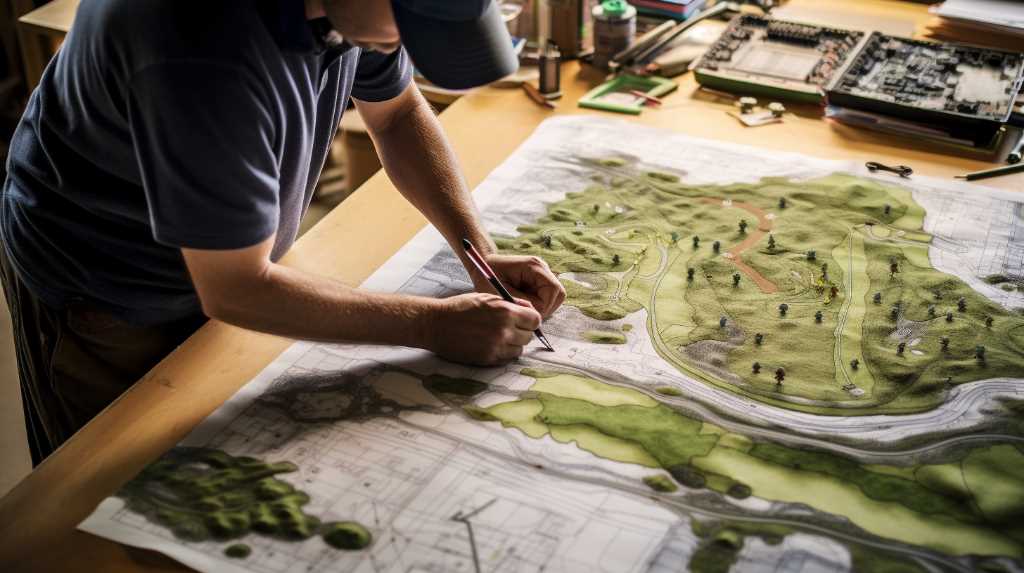
Do you ever wonder how golf course architects create those challenging holes that test your skills?
Well, they carefully analyze the topography and natural features of the land, strategically placing hazards and obstacles to keep you on your toes.
They also consider your playing strategy and skill level, incorporating risk-reward opportunities to add excitement.
Through their expertise, golf course architects create memorable and unique hole designs that make every round a thrilling experience.
Understanding Player Strategy and Skill Levels
As a golf course architect, you must consider the varying player strategies and skill levels when designing challenging holes. It's essential to create a layout that tests the abilities of both amateur and professional golfers.
One way to achieve this is by strategically placing hazards and obstacles throughout the course. For instance, you might position bunkers and water hazards strategically to challenge players to make accurate shots.

Additionally, you should take into account the different strategies that players may employ when approaching a hole. Some golfers may prefer a conservative approach, while others may be more aggressive. By providing options such as multiple fairway widths or varying pin positions, you can cater to different player strategies.
Ultimately, understanding player strategy and skill levels is crucial in creating engaging and challenging holes on a golf course.
Analyzing Topography and Natural Features
To design challenging holes, golf course architects analyze the topography and natural features, strategically utilizing the landscape to test players' skills. By studying the lay of the land, architects can identify natural slopes, hills, and valleys that can be incorporated into the design. These natural features can add complexity and difficulty to the holes, requiring players to carefully consider their shots and adjust their strategies accordingly.
For example, a hole with an elevated tee box and a fairway that slopes downward can present a challenge in terms of club selection and shot accuracy. Additionally, architects may also take into account the presence of water bodies, trees, and bunkers, strategically placing them to create obstacles that players must navigate.
Strategic Placement of Hazards and Obstacles
By strategically placing hazards and obstacles, golf course architects challenge your skills and decision-making abilities. They carefully consider the layout of the course to create a balance between difficulty and playability.
Hazards like bunkers, water bodies, and trees are strategically positioned to make you think twice before taking a shot. These obstacles force you to analyze the risks involved and make strategic choices. For example, a bunker strategically placed near the green may tempt you to take a more aggressive approach, but it also increases the chances of a wayward shot ending up in the sand.
This strategic placement of hazards adds an element of excitement and challenge to the game, testing your ability to navigate the course successfully. As you encounter these obstacles, you must weigh the potential rewards against the potential risks, which leads us to the next subtopic: incorporating risk-reward opportunities.

Incorporating Risk-Reward Opportunities
You will encounter numerous risk-reward opportunities that challenge your decision-making skills on a golf course designed by architects. These opportunities are strategically placed throughout the course to provide players with the chance to take calculated risks for potentially greater rewards.
Architects carefully analyze the layout of the course, considering factors such as distance, wind direction, and terrain variations, to create these enticing opportunities. For example, they may design a hole with a narrow fairway lined with bunkers on one side and a water hazard on the other. The golfer must decide whether to play it safe and aim for the wider side or take a risk and go for the shorter, but more challenging route.
Creating Memorable and Unique Hole Designs
When designing challenging golf holes, architects aim to create memorable and unique designs that engage players and test their skills. They understand that golfers remember the holes that stand out from the rest, the ones that offer something different and exciting.
To achieve this, architects incorporate various elements into their designs, such as strategically placed hazards, dramatic changes in elevation, and unconventional hole shapes. These elements not only make the hole visually appealing but also create opportunities for players to think strategically and make calculated decisions.
Architects also strive to create holes that challenge different aspects of a player's game, from their tee shots to their approach shots and putting.
Conclusion
So, next time you step onto a challenging golf course, remember that every hole has been carefully designed by a golf course architect. They consider player strategy, analyze the natural features of the land, strategically place hazards and obstacles, and create unique designs to create a memorable experience.
It's their expertise and attention to detail that make each hole a test of skill and strategy, ensuring that every round is both challenging and enjoyable for golfers of all skill levels.