We take two briskets and cook them the exact same way, except one gets the dry brine treatment overnight and the other does not. They are both seasoned with the same SPG rub with lots of super coarse ground pepper, salt and garlic. Both had the flats injected, both were foiled with beef tallow, both were smoked in identical Green Mountain pellet grills at roughly the same temp, both were put in the Cambro for the same amount of time. All to answer if you should dry brine smoked beef brisket with a side by side experiment.
There have been a lot of debates about how to smoke brisket, with these three being some of the most often debated: Fat cap up, or fat cap down? Beef tallow or no beef tallow when wrapping? Foil vs Butcher Paper for Brisket? A quick note on that last one as it relates to this experiment. Yes, butcher paper is better. But please stop castigating people who use foil. We all did for many decades and still do. That BBQ was not trash because butcher paper is a little better. Using foil to wrap still makes amazing BBQ. The biggest trolls on the subject are usually the people who cry bloody murder that their steak is 5 degrees off. Don’t be that guy.
And before anyone jumps into the aluminum foil is a health hazard, realize that’s only at high temps. Think 400F plus. We never crested 250F.
For those doing your research on brisket, this is less about the recipe and more about the side-by-side experiment of the effects of dry brining vs not dry brining.
For more detailed brisket recipes, we have these:
And we have two recipes for leftover brisket
Should You Dry Brine Smoked Beef Brisket Ingredients:
- 2 whole packer briskets (point and flat included), trimmed – these were prime grade briskets, which at the time of the writing of this post was only a dime a pound more expensive than choice. I’m not kidding.
- Salt pepper garlic seasoning, or your favorite beef rub – We also added some extra super coarse pepper
- Store bought meat injection
- Beef tallow
Equipment Needed:
- Aluminum foil or butcher paper
- A cambro or empty cooler
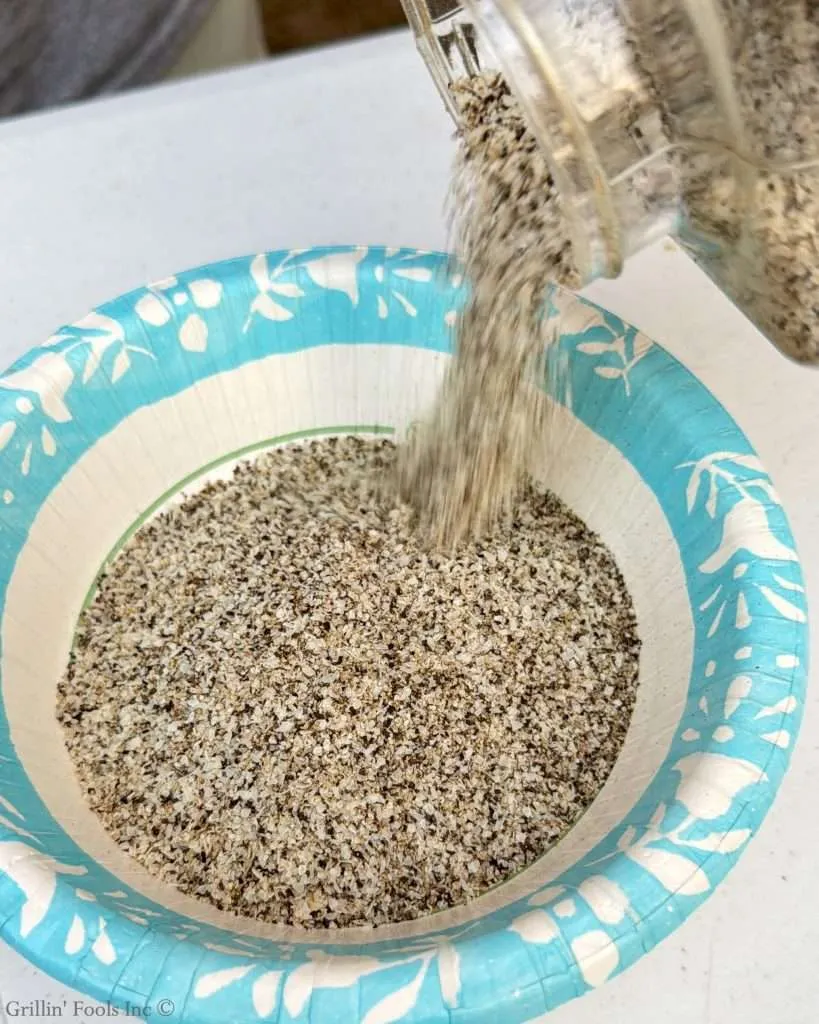
For the seasoning/BBQ rub we used a standard SPG rub:
And then we mixed in some very coarse ground pepper:
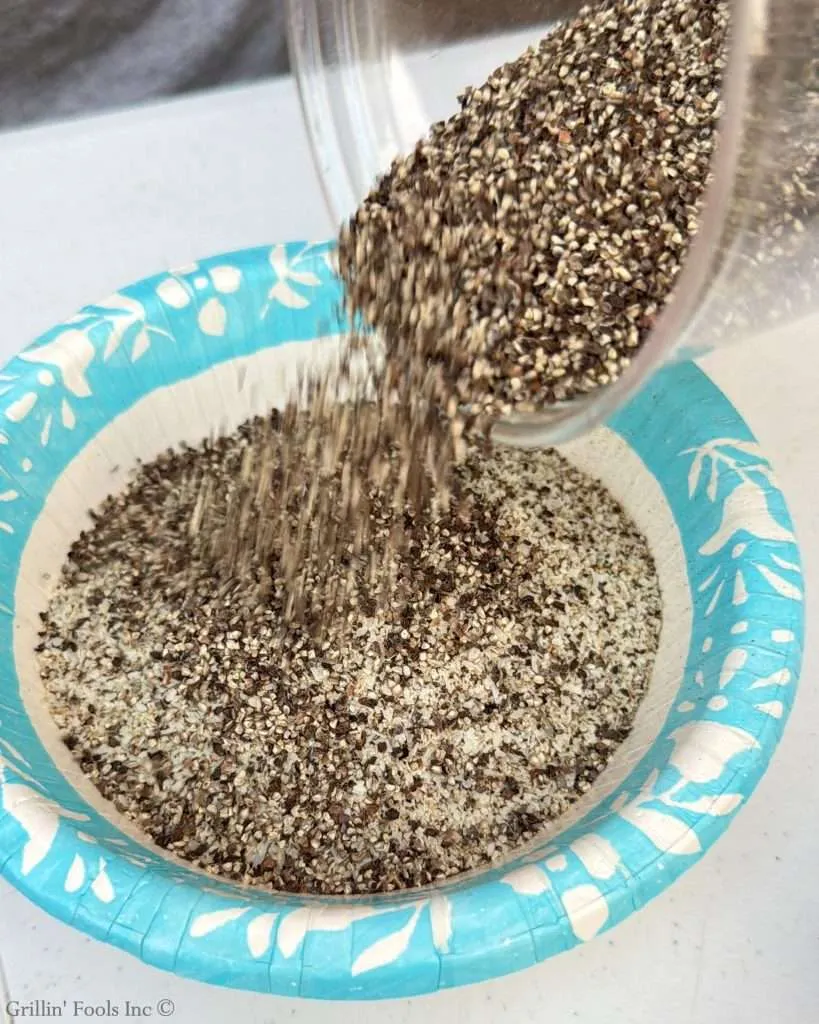
Technically, that pepper is 16 mesh, which just means it is not ground fine at all and is very, very coarse. Which lends itself nicely to a slice of brisket that only has seasoning around the outer edge.
With such a large meat-to-bark ratio, one must hit that seasoning hard on brisket
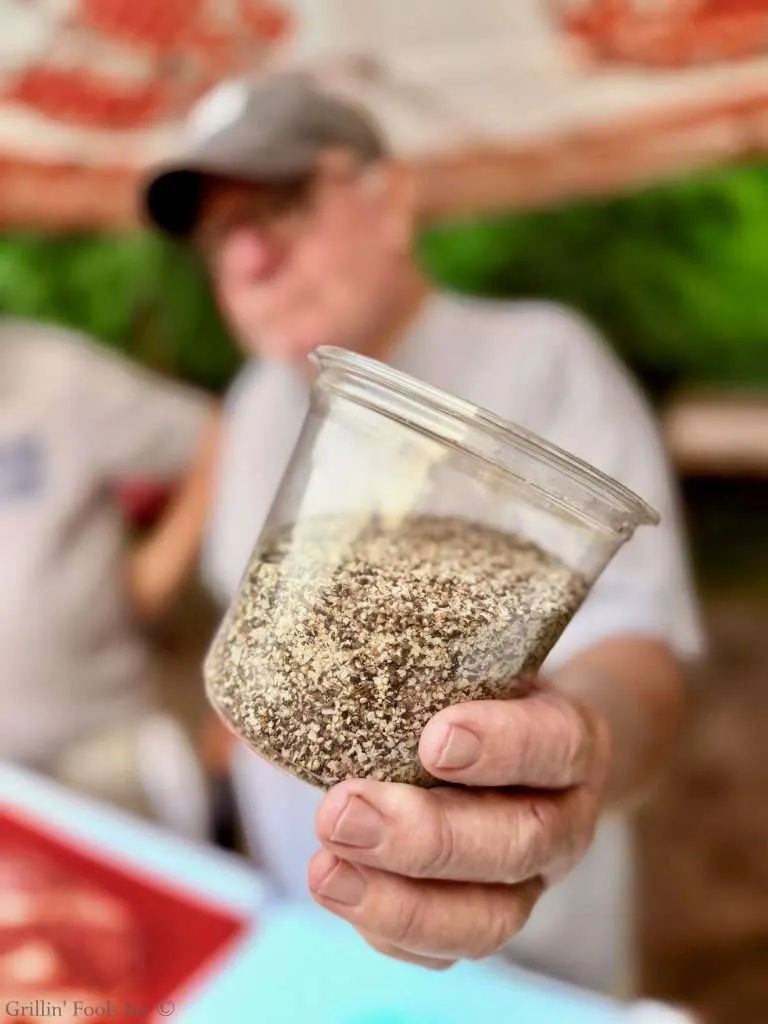
The SPG and added pepper were poured into a plastic jar which just took a shake to blend completely:
Dry Brine Instructions
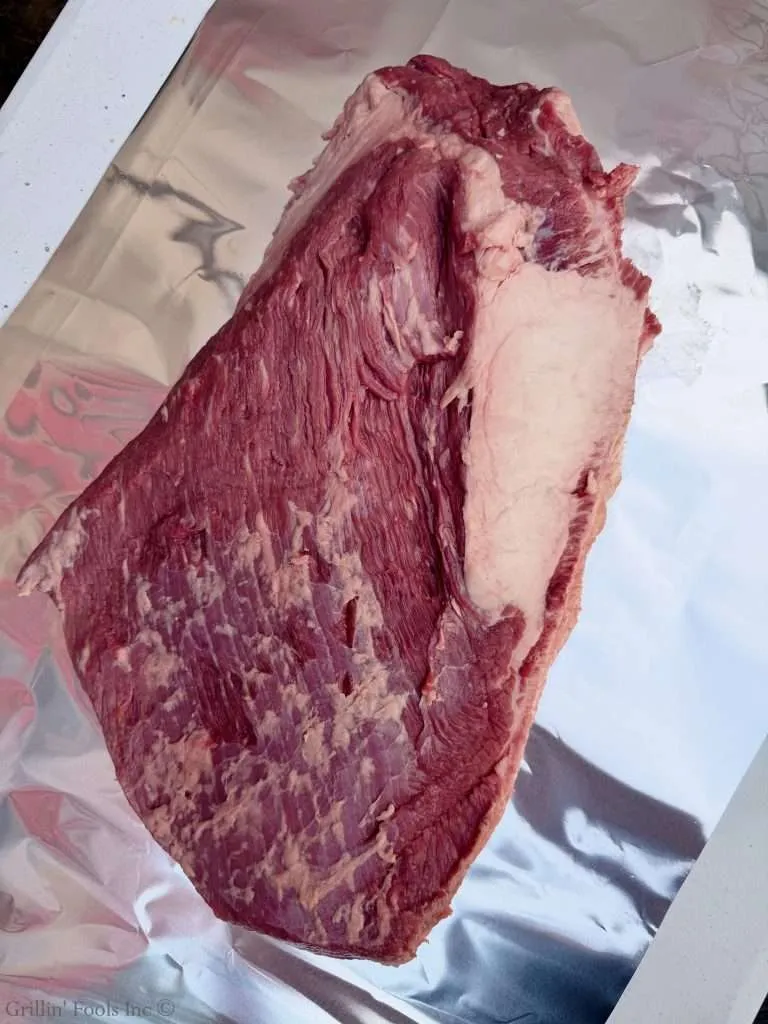
The night before the cookout, both briskets were removed from the packaging and trimmed. We carved off any thick globs of fat from the meat side and thinned out some of the fat cap, but left it largely intact:
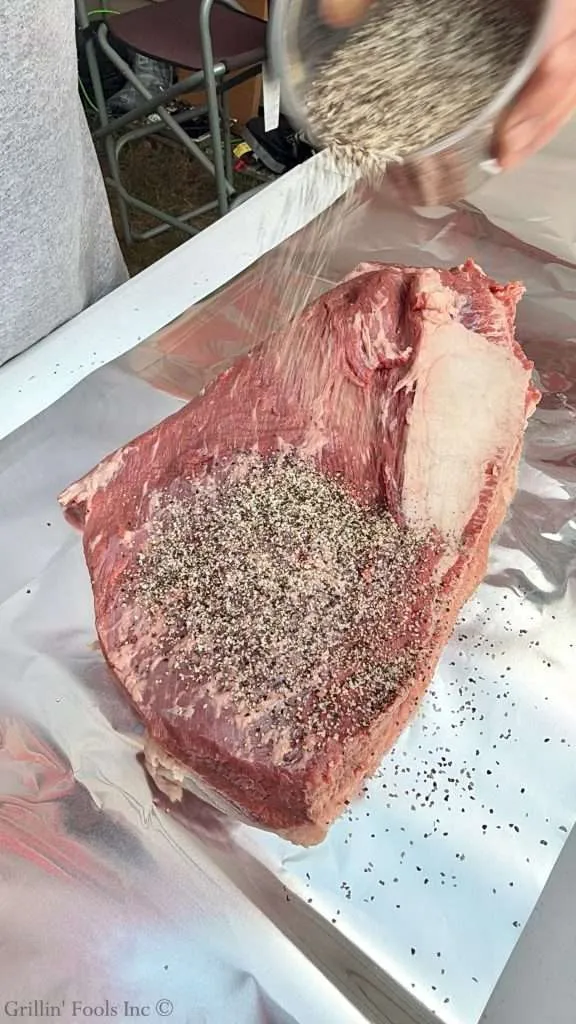
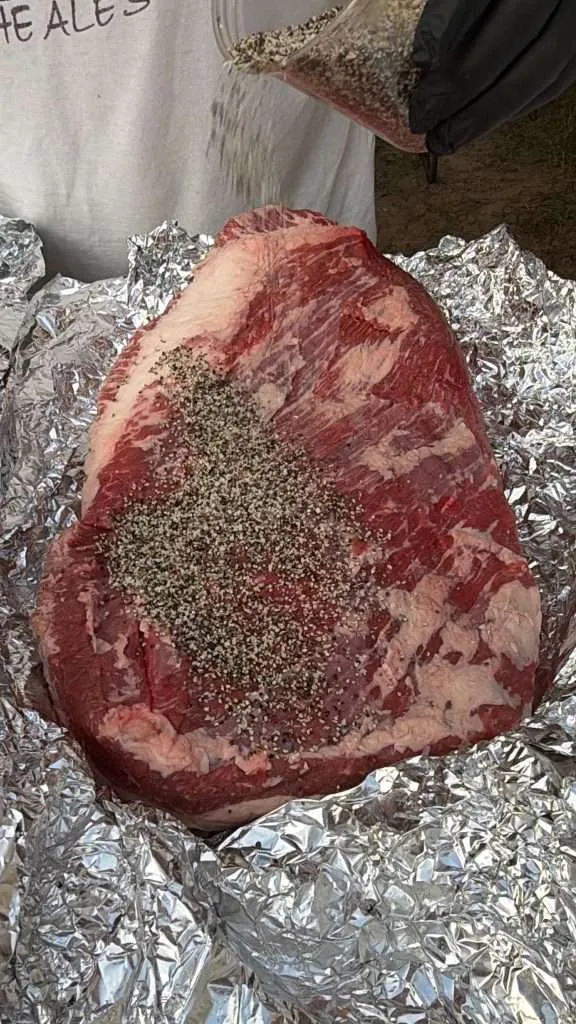
Then we took our SPG rub with that bonus super coarse pepper and coated one of the packer briskets top and bottom and the outer edge:
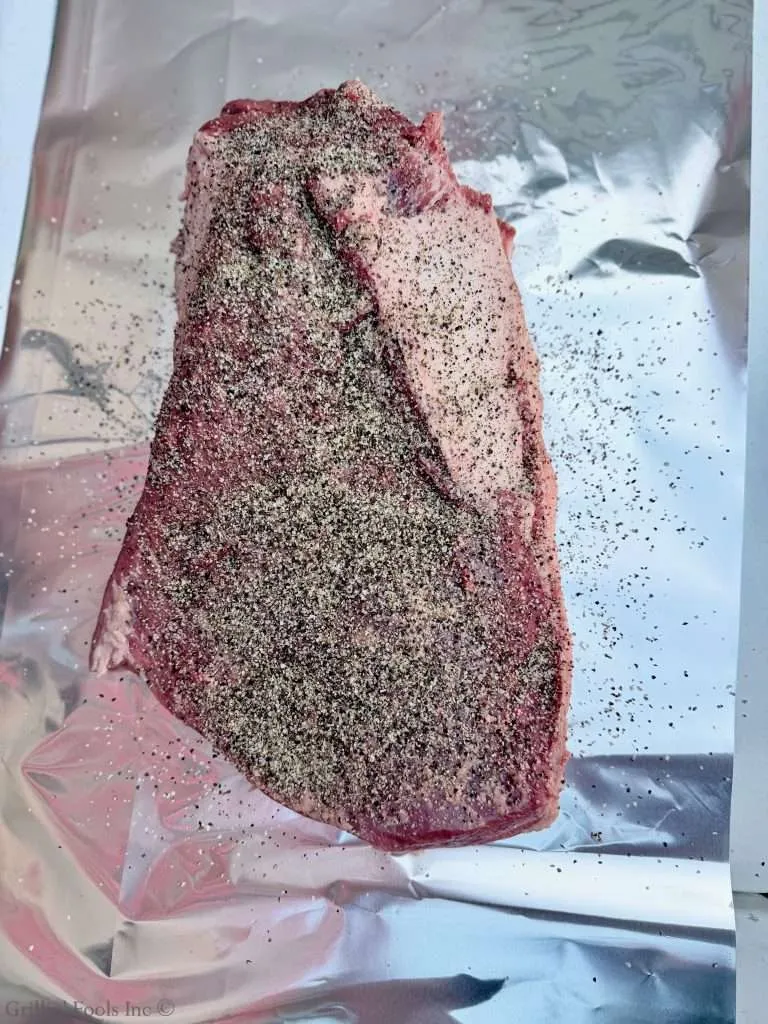
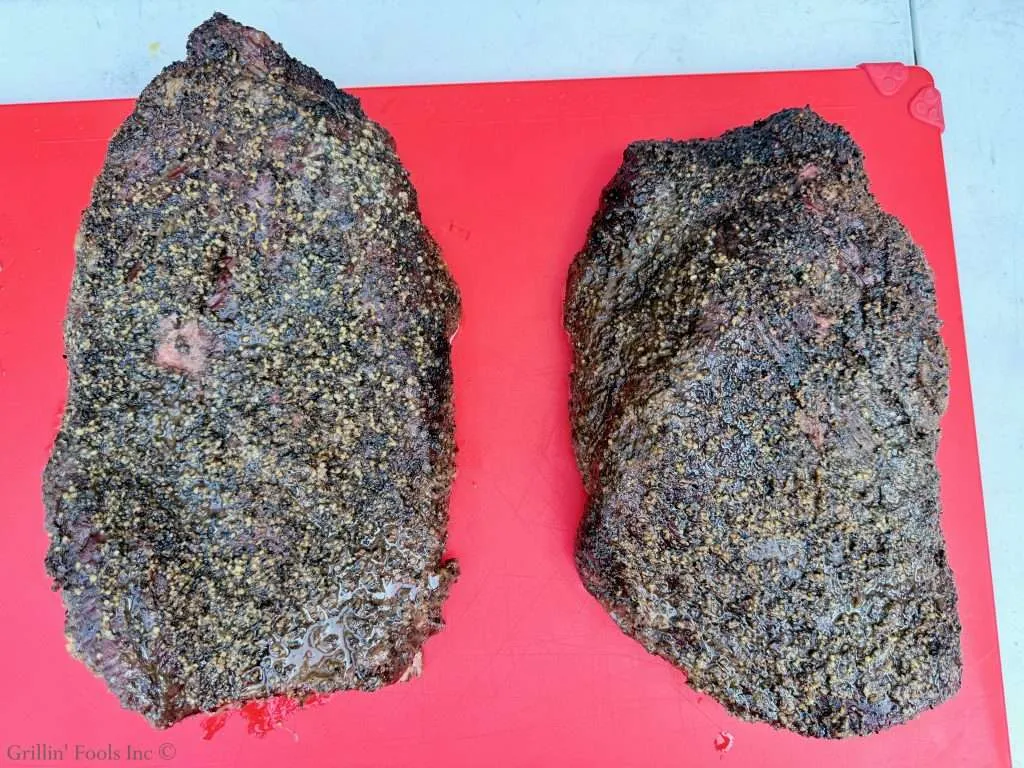
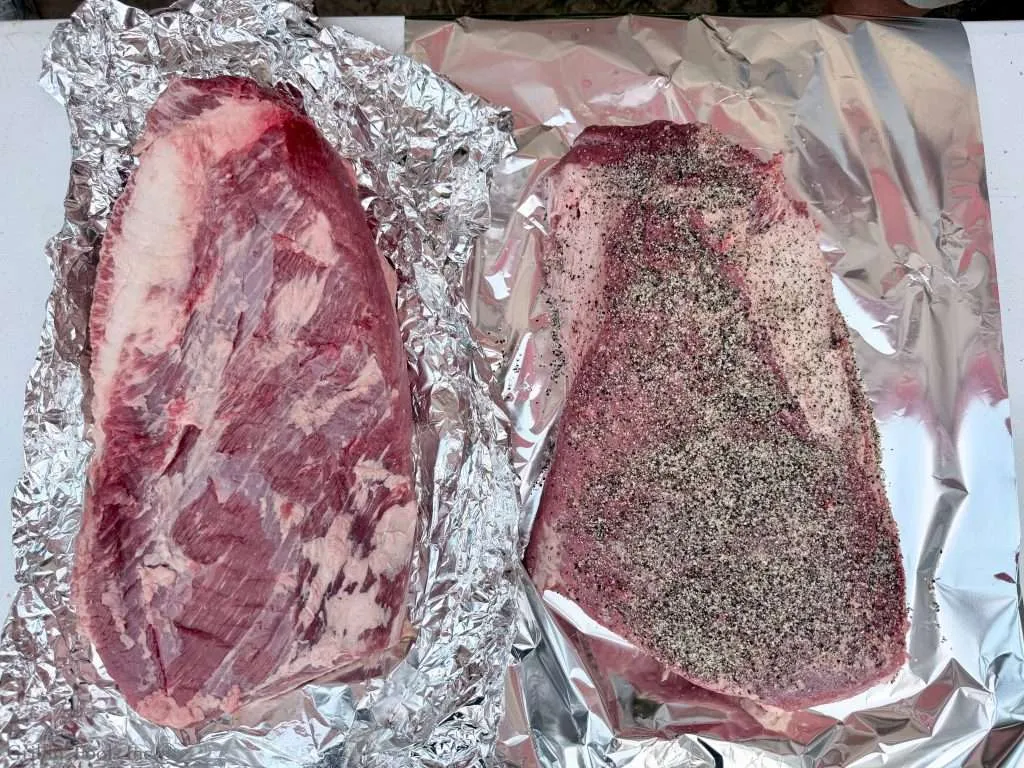
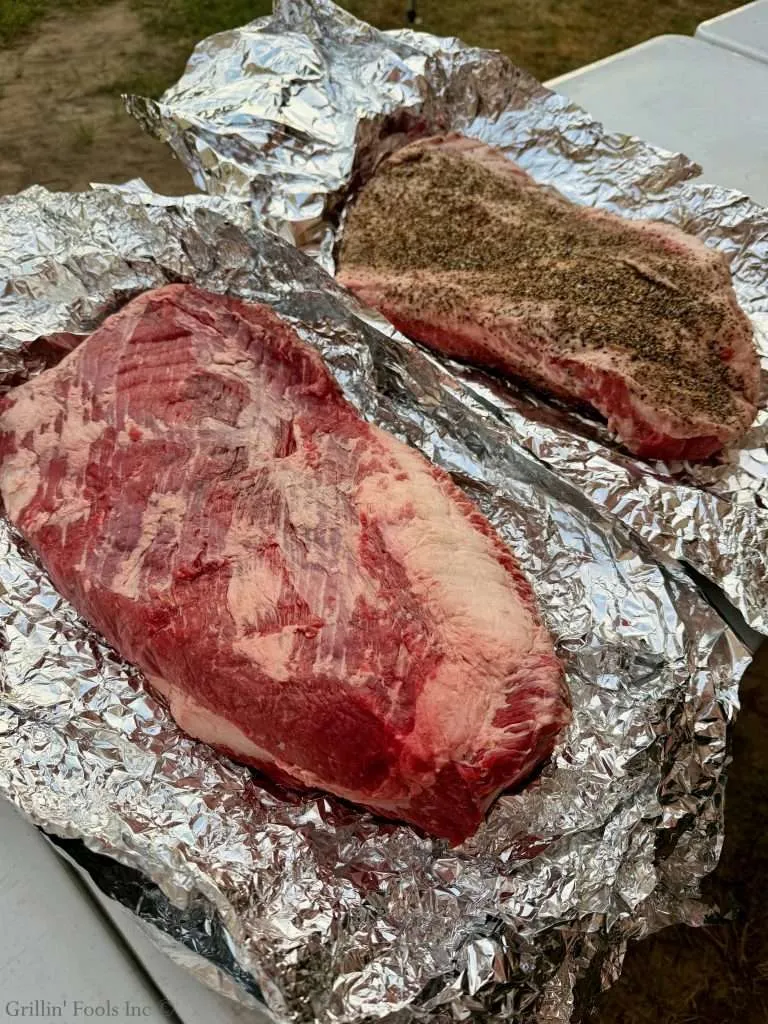
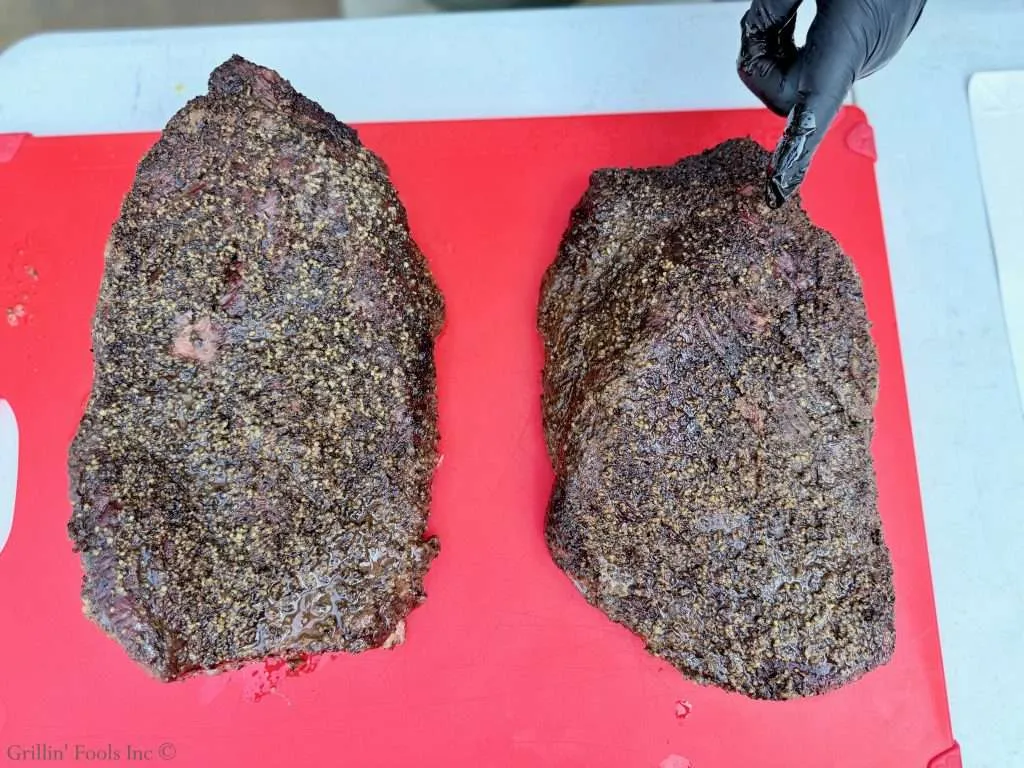
Here are the two prime grade briskets, one seasoned entirely for a dry brine and the other bereft of any seasoning:
Both briskets were wrapped in foil and refrigerated overnight.
That’s it.
Dry brining is just seasoning the meat the night before so some of that seasoning works its way into the meat over many hours.
Season the other Brisket the Morning of
The following morning as the Green Mountain Grills travel smokers were brought up to 250F the other brisket was seasoned with the remainder of the seasoning from the previous evening:
The one on the left is the one we dry brined over night. The seasoning is a bit darker as the salt has mostly dissolved while the one on the right that was just seasoned:
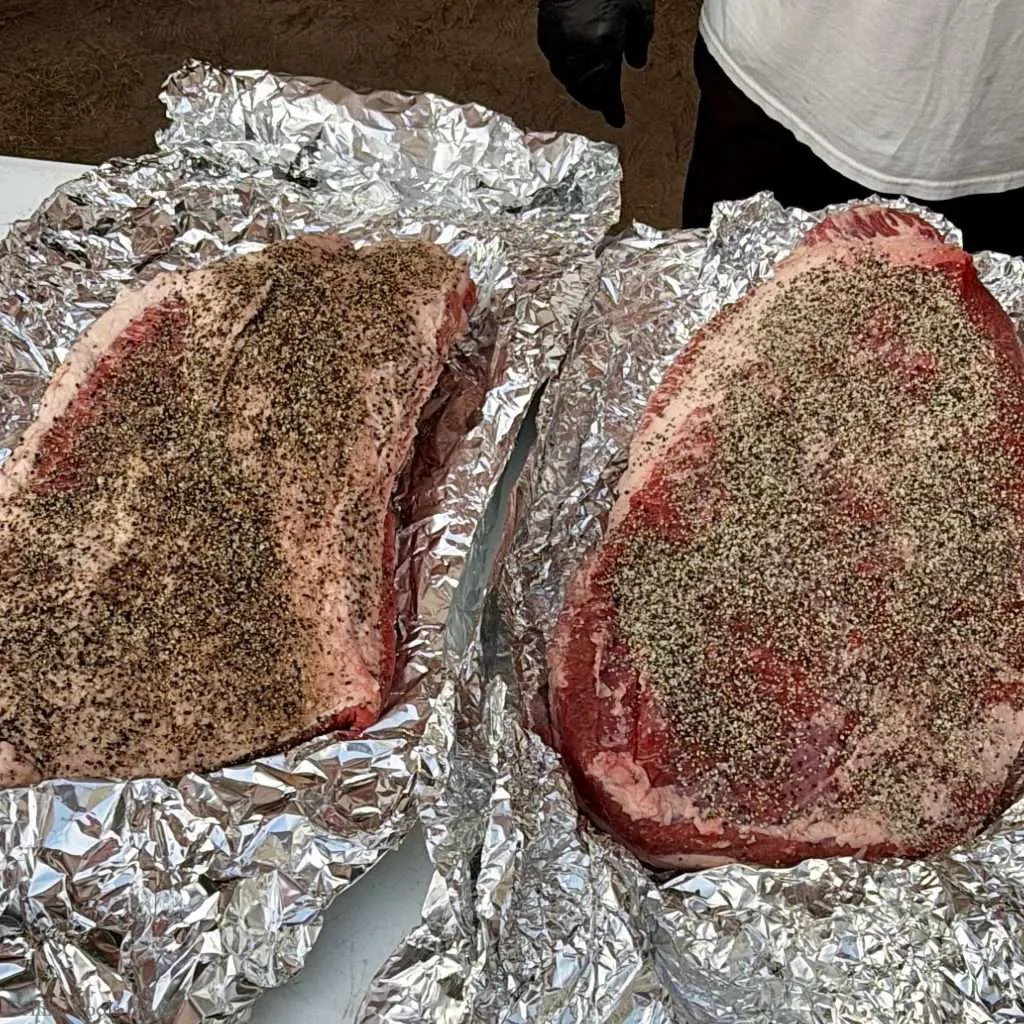
Editor’s note ~ The biggest difference between these two briskets is the weight. The one we dry-brined was 12.75 lbs. The one we seasoned the following morning was 15.75 pounds. We had limited options on smaller briskets since we are using travel grills for this cook while up at the cabins in Northern Michigan. But we didn’t cook these briskets to time. We cooked them to temp. One got done earlier, simple as that, and thus spent a little more time in a Cambro than the other one, but both spent close to 3 hours resting.
Inject the Brisket Flats
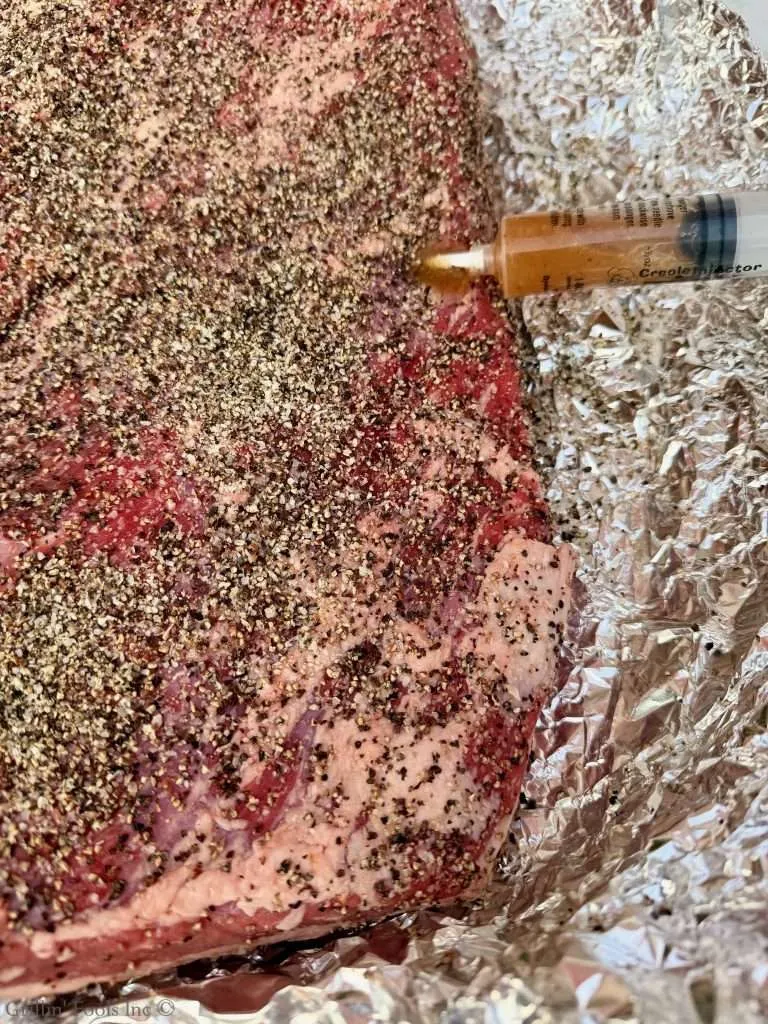
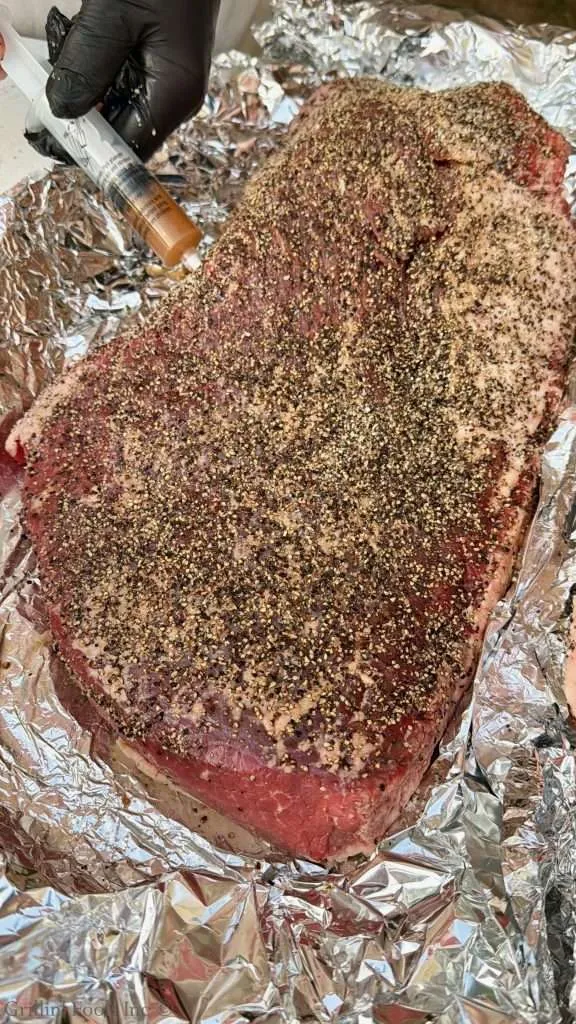
Now that both briskets are seasoned, we have one more step before we can smoke them. And this one is taken directly from the competition circuit. It’s a popular thing to inject the flats with something flavorful. Could be butter. Could be beer. Might be bourbon or a concoction of all three. In this case, we just got that stuff we use every year on the turkey and injected a little Cajun flavor into our brisket flats.
We didn’t inject the points as the points have way more fat and marbling than the flats and flat-out don’t need it.
See what I did there?
How to Smoke the Briskets
We haul two Green Mountain Grills travel grills (the model is appropriately called the Trek) with us on vacation. And they are great for feeding the whole crowd of anywhere between 22-30 people that go every year. We usually do 3-4 pork shoulders on another night. Each travel cooker can handle two whole shoulders. We’ve been using Green Mountain Grills travel cookers for more than 10 years. A good pellet cooker like this is worth its weight in gold for Thanksgiving alone.
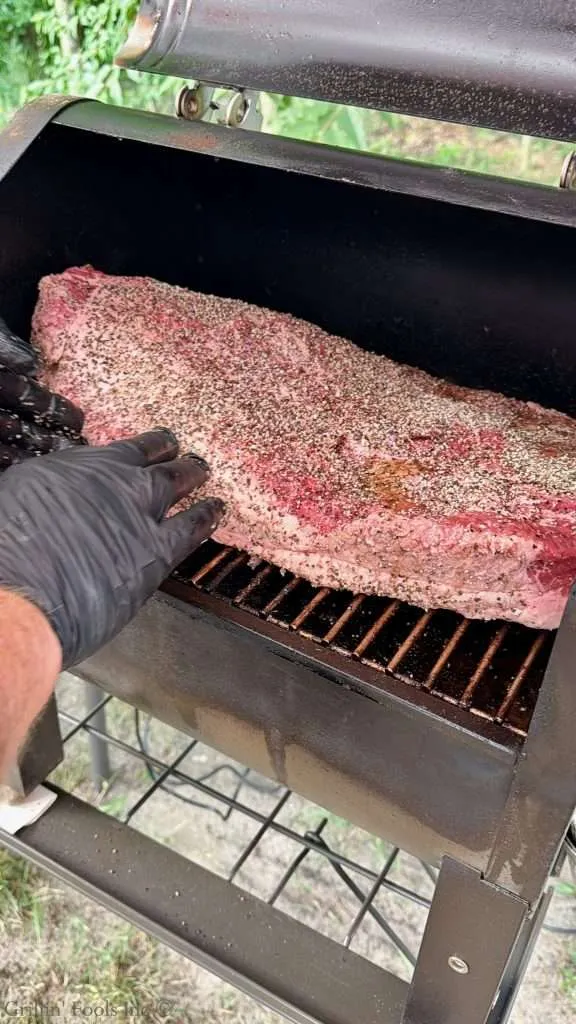
Each pellet cooker was set to 250F and we used oak wood pellets. Each brisket went into its own smoker:
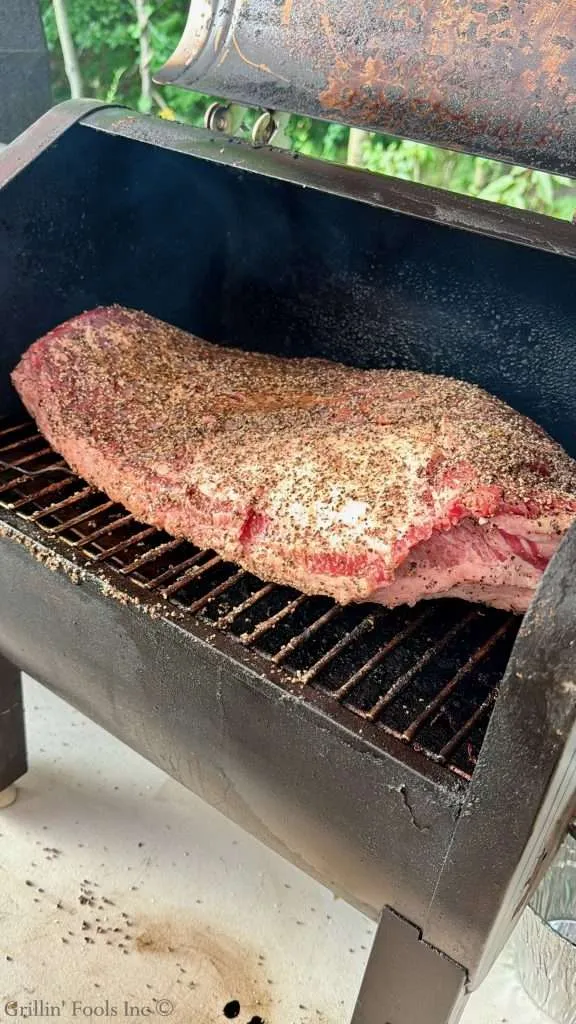
Our briskets are coloring up nicely after 3 hours in the smokers.
These are about 145F degrees:
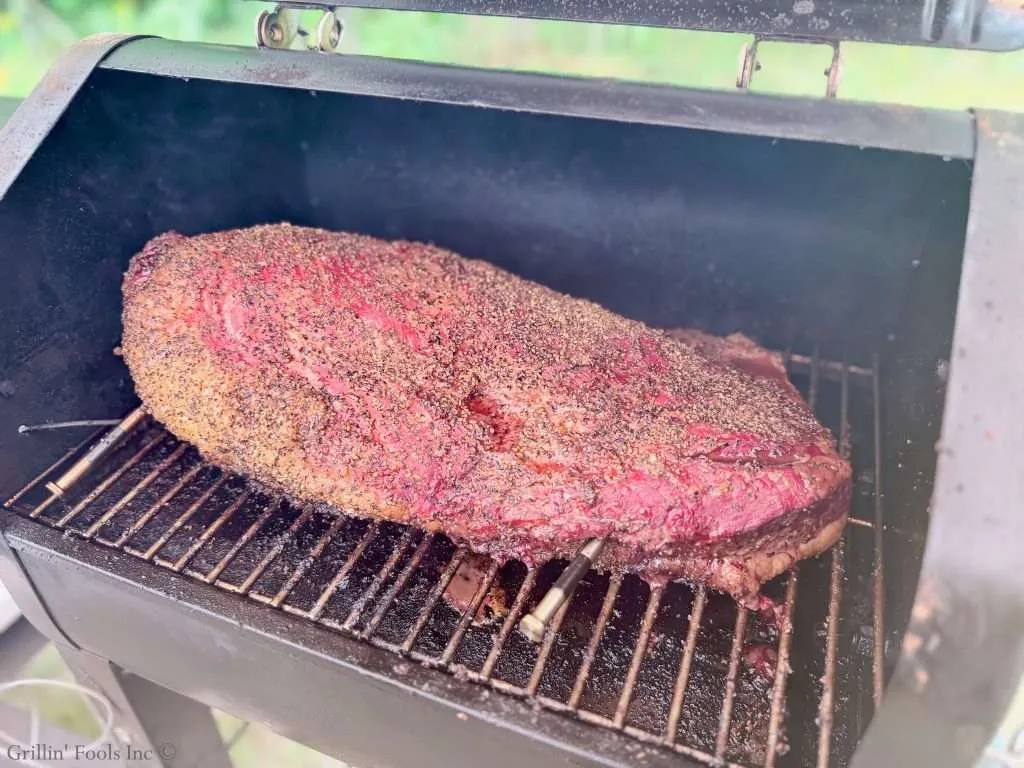
Who says pellet grills don’t have any smoke:
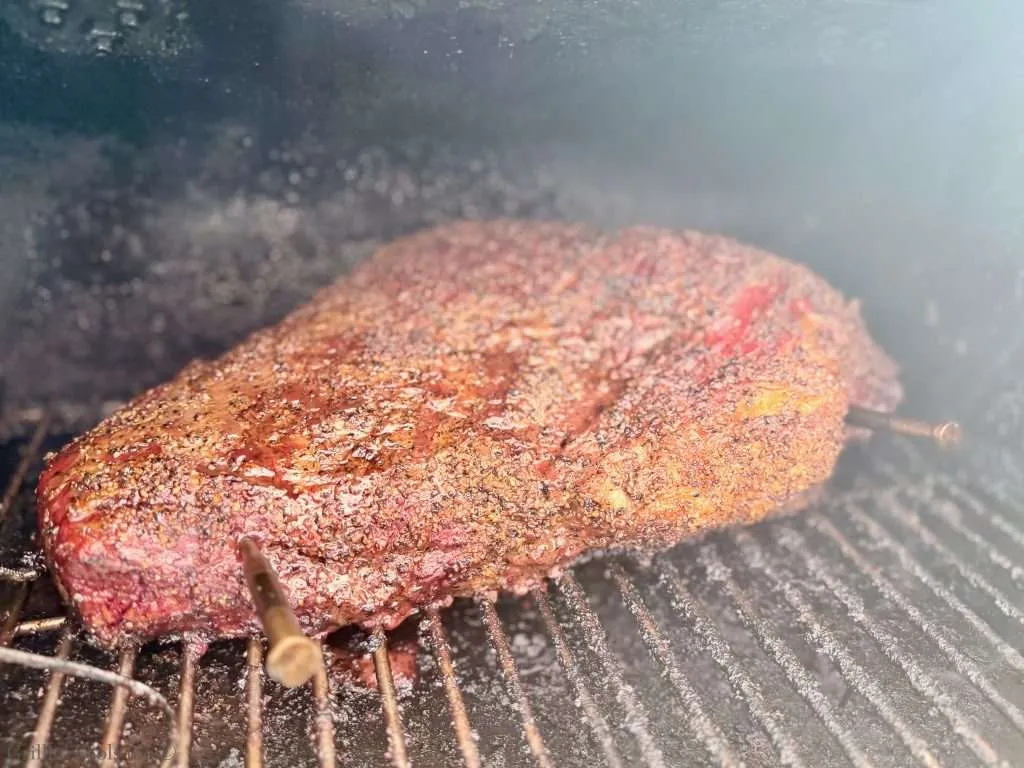
The briskets are in the stall and it’s time to wrap them. This begs three questions:
What is the Stall?
The stall is when the slow steady rise of the internal temperature of a brisket (or other large roasts) plateaus and levels off. It’s as if the brisket is no longer cooking but it is. The stall is quite maddening because it can last for hours and there’s no way to know how long there is left or when it will end. Only when the internal temp of the brisket starts to rise again is the stall over. Generally is starts between 150F-170F and goes until the temps climb again.
Why Wrap Brisket?
Wrapping in either foil or butcher paper allows the brisket to steam in its own juices, which hyper-accelerates the breakdown of connective tissue and speeds up cooking times without drying out the meat. It is just about the only way to speed up the stall. While butcher paper breathes, and foil doesn’t, butcher paper results in a better bark as the bark can be more soggy if wrapped in foil. That being said, wrapping in foil still makes an amazing brisket so don’t sweat it if you have a hard time finding butcher paper and all you have is foil.
When to Wrap Brisket?
Most pitmasters wrap when the brisket hits right around 160F. While this is generally a good rule of thumb, I prefer to let the brisket tell me when to wrap. In particular, the bark. Bark is the dark (almost black) outer layer of the brisket that results from the combination of seasoning, fat exuded from the cooking process, heat, and smoke. That black bark looks a little burnt to the novice, but it’s the tastiest part of the brisket. When that bark is nice and dark is usually when I like to wrap. After most of the rosy color is gone.
Time to Wrap
Lay down a large sheet of aluminum foil or butcher paper and set the brisket in the middle:
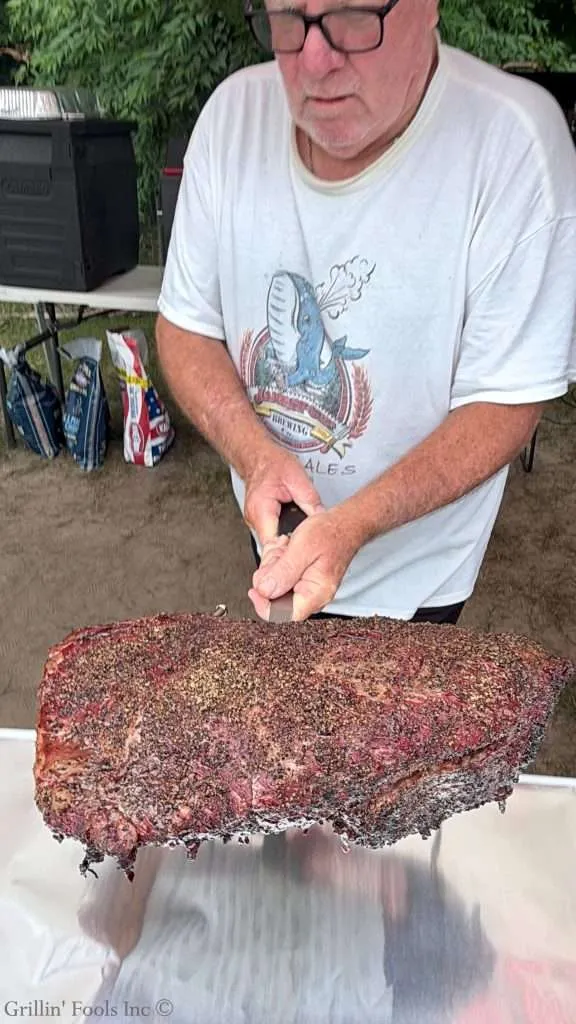
Here’s a glimpse behind the scene in our world. This is dad filming the brisket going from the smoker to the table with the foil:
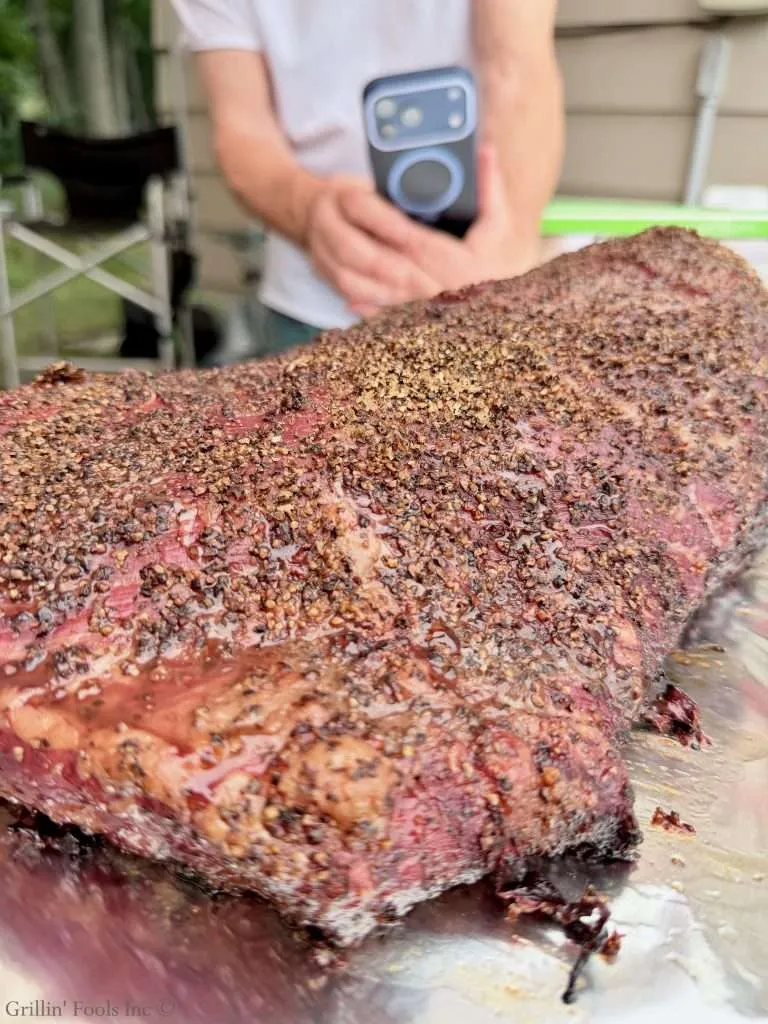
And this is me filming the same thing from a different angle which caught that pic above:
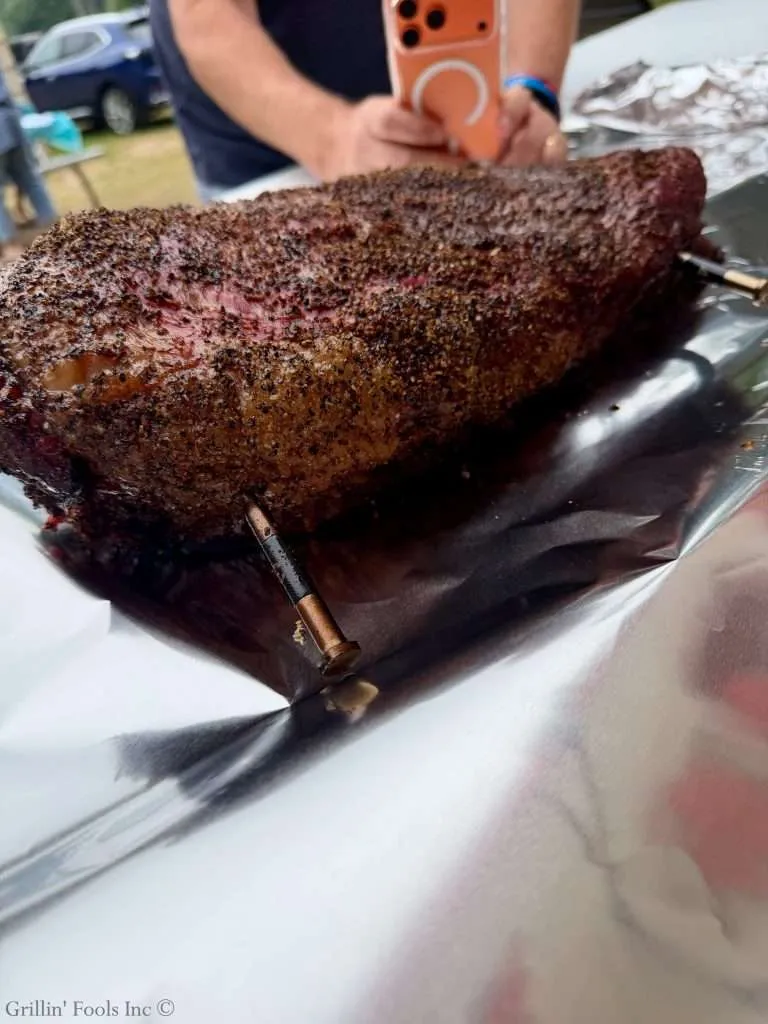
If you scroll down, there’s a video of this where you will see both of those angles when the first brisket comes out of the smoker to be wrapped.
OK, back at the task at hand.
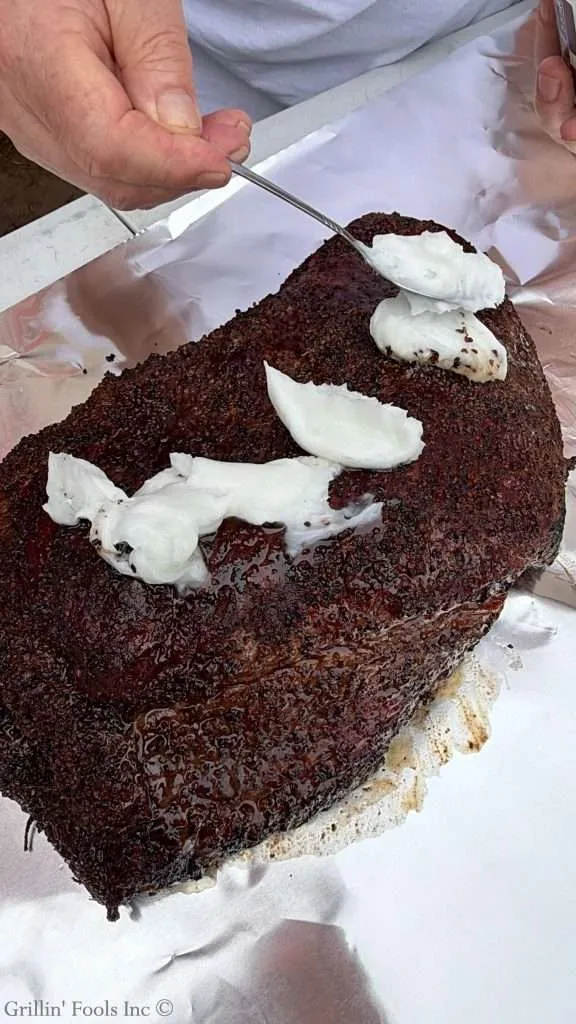
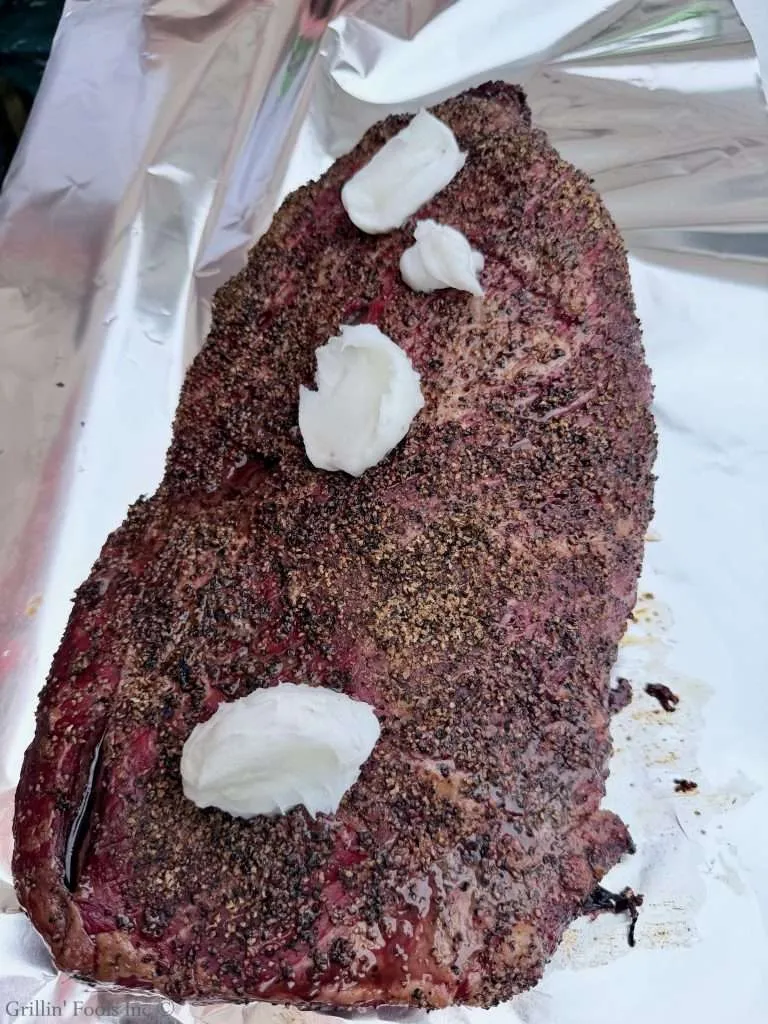
Three large dollops of beef tallow go on top:
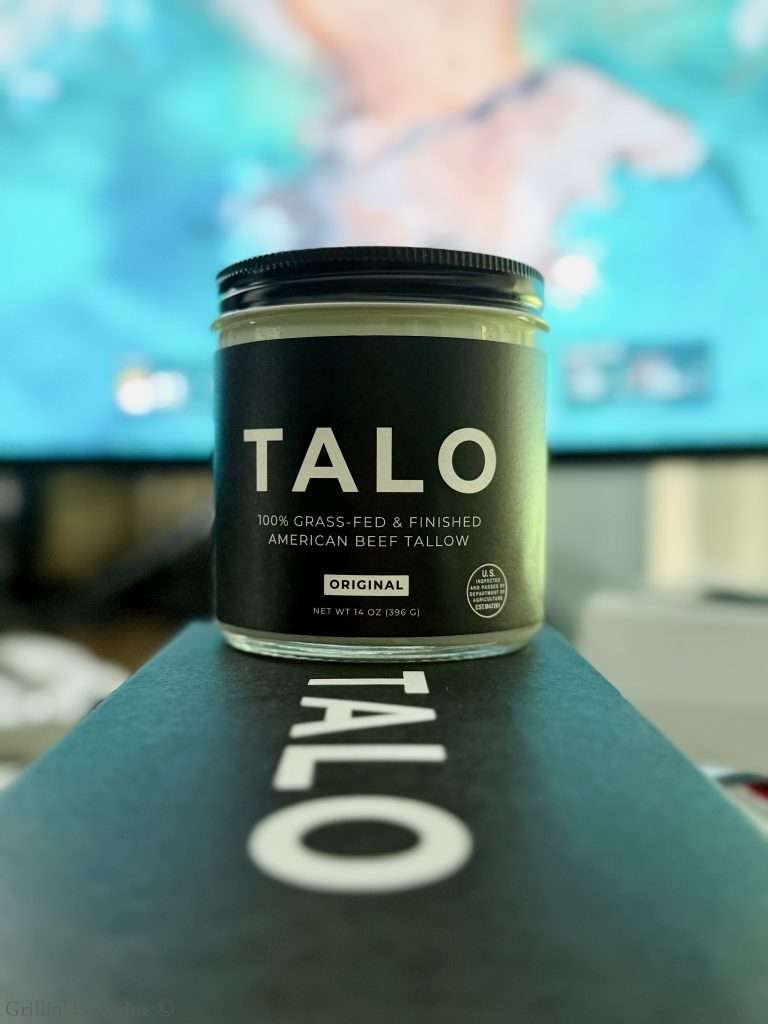
BTW, if you’re looking for beef tallow, might I suggest the stuff we use called Talo:
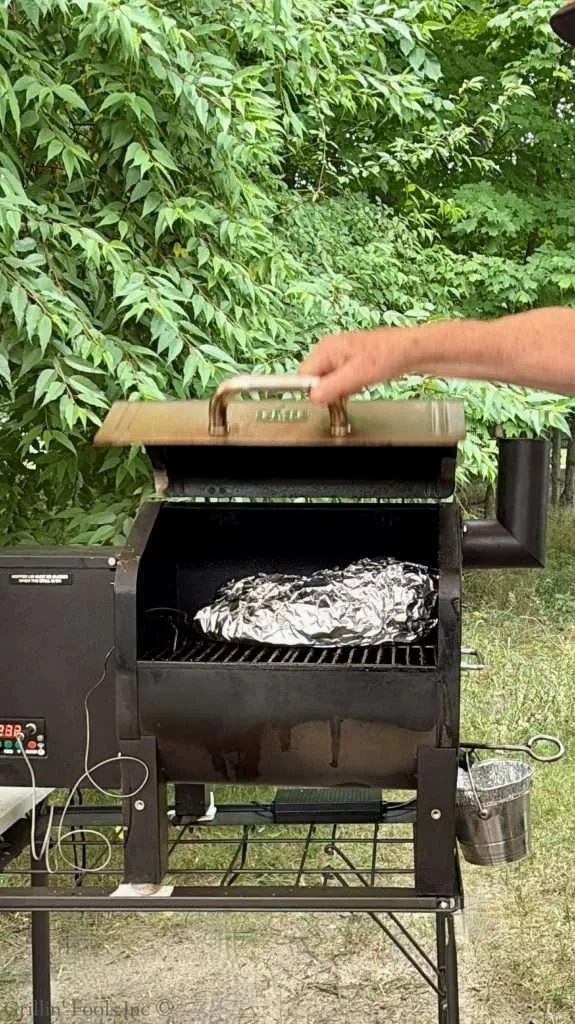
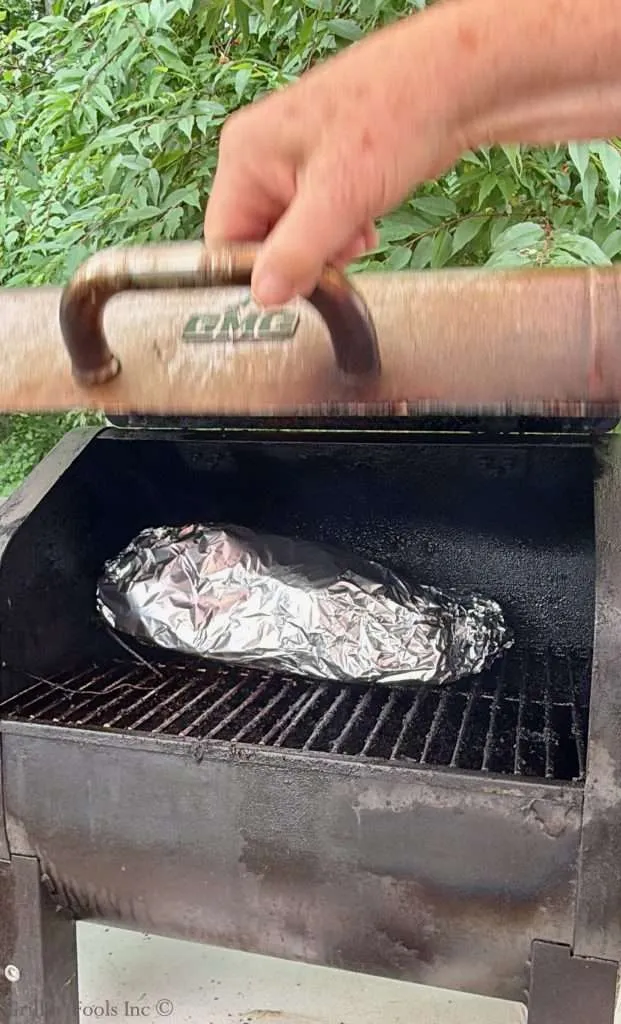
After the tallow is applied, the brisket is wrapped up in foil and is inserted back into the smoker:
And here’s the other one with the dollops of beef tallow:
And the foiled brisket is back on the grill:
Time to Rest the Briskets in the Cambro
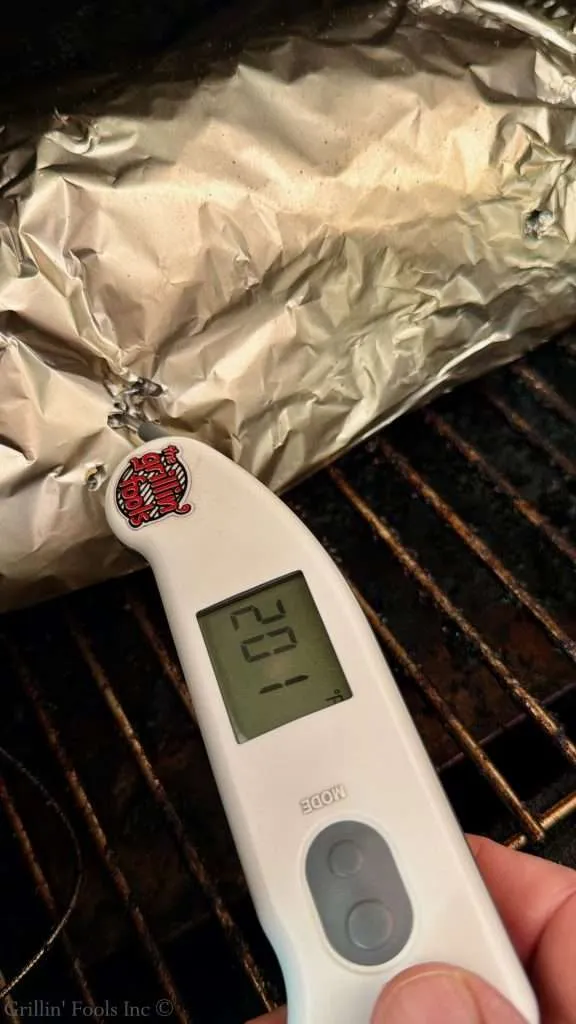
Both of the briskets were pulled with an internal temperature between 200F-201F and placed in the Cambro.
If you don’t have a Cambro
Take the brisket out of the smoker, leaving it wrapped in foil or butcher paper and wrap it in a couple towels and drop it in an empty cooler. It will stay hot in there for 2-3 hours. A Cambro will keep it hotter for many more hours, but the cooler will work well enough. The better the cooler the longer the hold time.
This is the exact Cambro we use. We bought it in 2020 and it still looks and performs like brand new.
After about 3 hours in the Cambro for each, the briskets were pulled to slice.
The one on the right that is being pointed at is the one we dry-brined:
Time to slice.
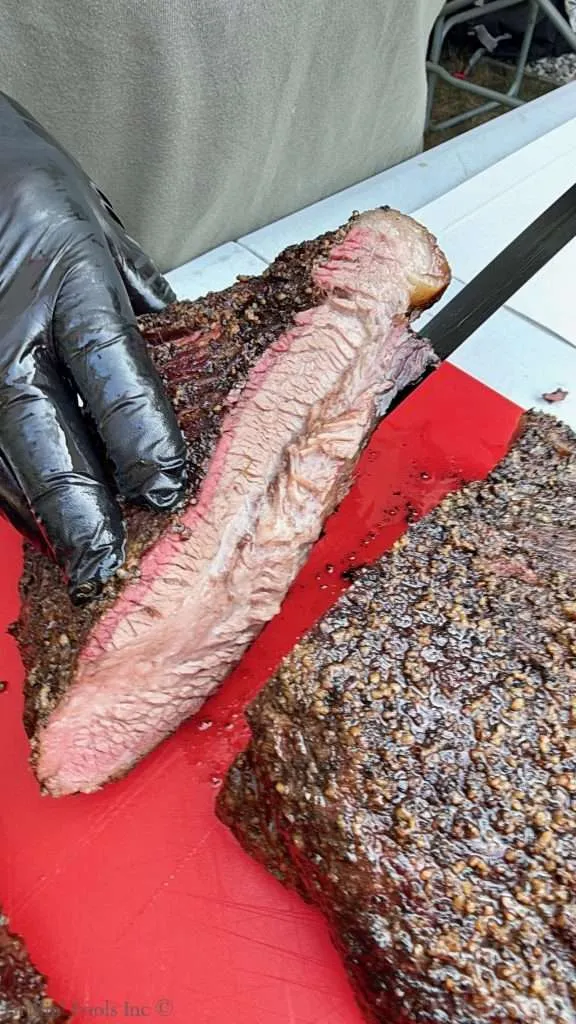
When slicing brisket, ALWAYS carve across the grain. Not doing so can turn a perfectly tender brisket into shoe leather. That’s not hyperbole.
The brisket that got the overnight dry brine treatment:
And the larger brisket we did not season over night:
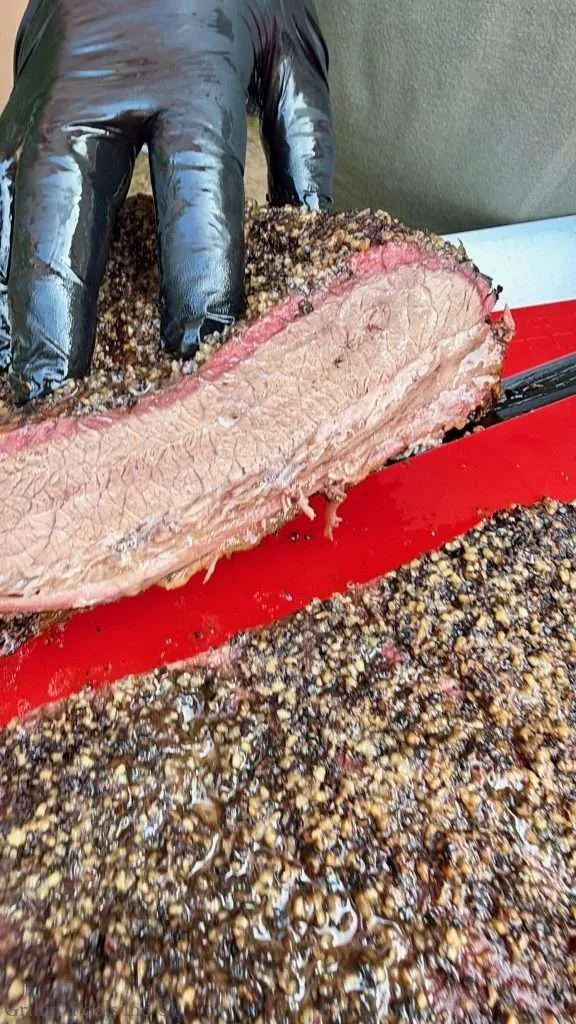
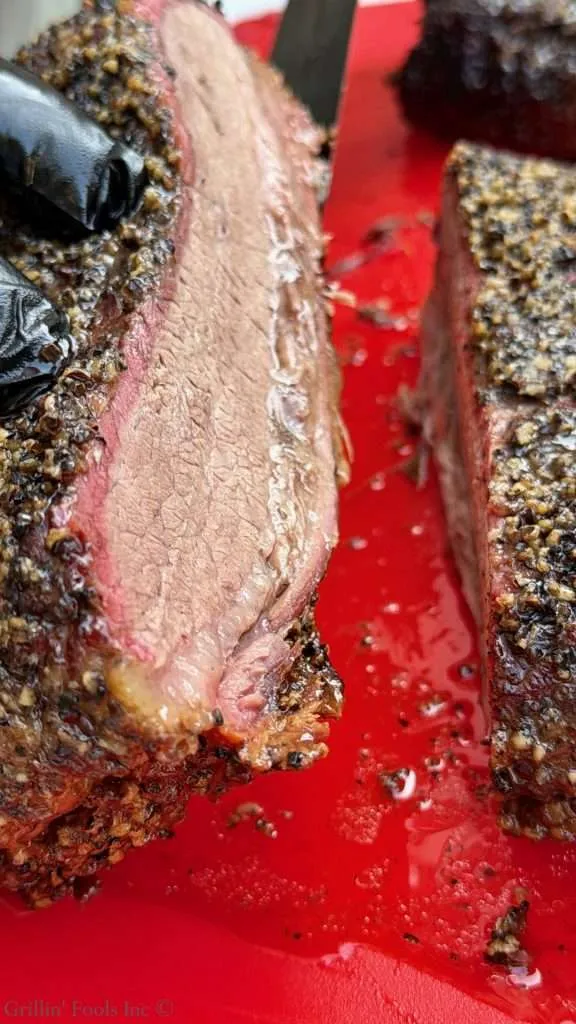
We have a little more flat in this slice as the point was more toward the end. That being said, here’s another shot to show how juicy it is despite having less point in the slice:
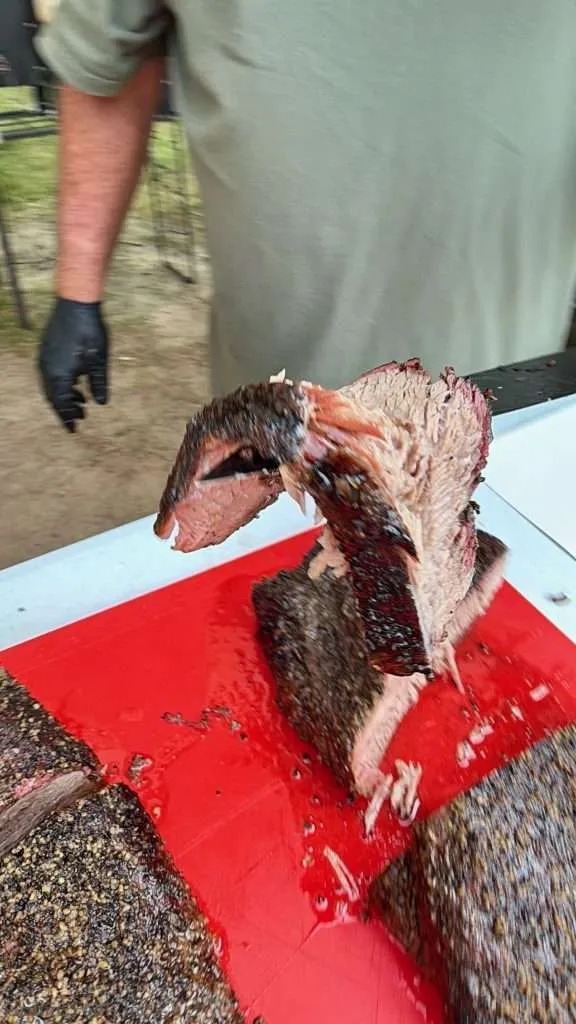
The Bend Test
The bend test it to take a slice of brisket and lay it over your pointer finger sticking straight out or over the back of a knife blade. The thicker the slice, the less bend. The thicker the slice usually indicates more confidence in your brisket cooking ability.
That being said, I’ve blown more than few briskets in my life and had to slice paper thin so it will be tender enough to eat and these slices are about three times as thick as what most people slice and they passed the bend test beautifully. Here are a couple pics of the brisket that got the dry brine doing the bend test:
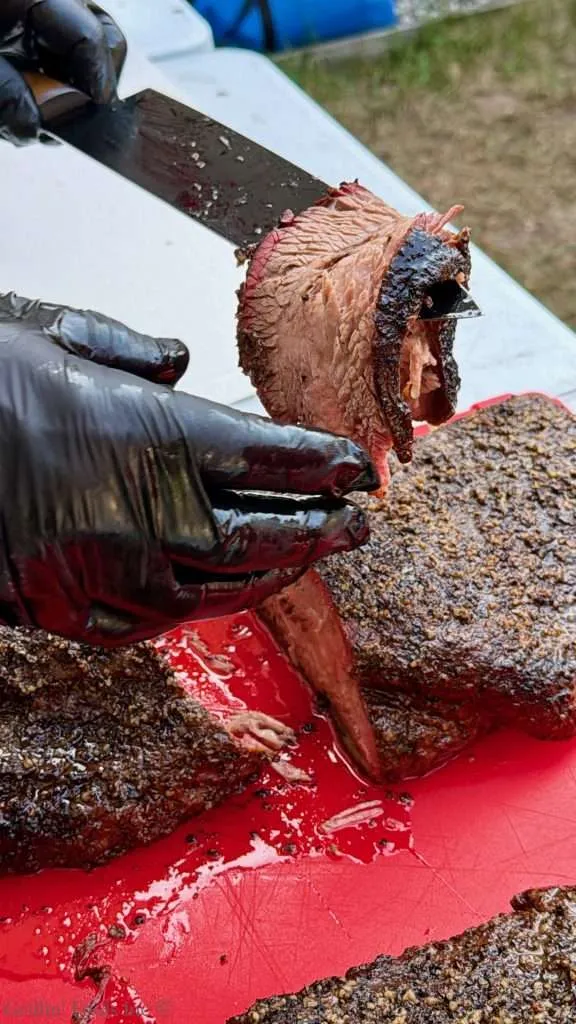
And here is the one we seasoned right before smoking:
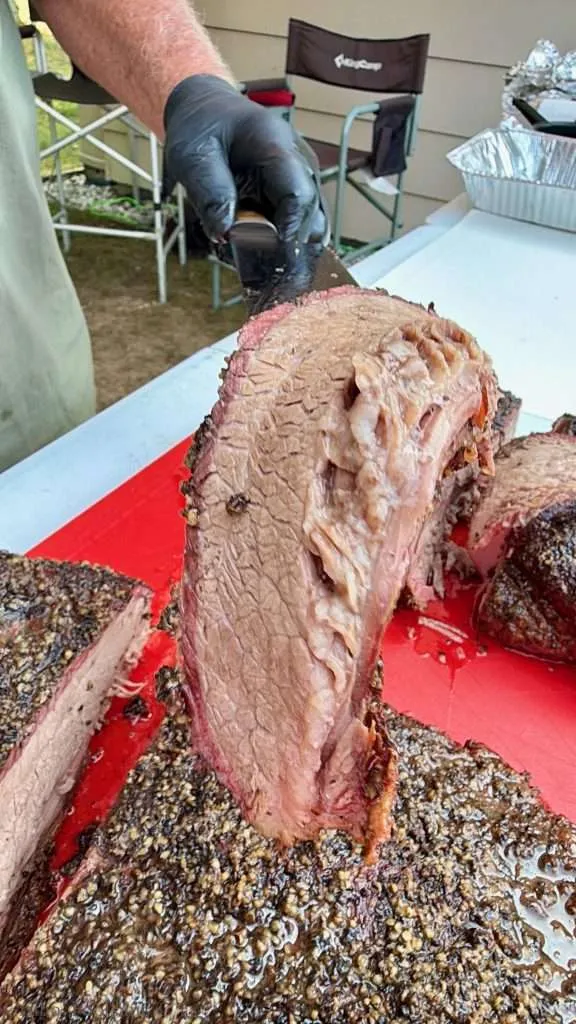
Here are the two slices we will be sampling from to do a side-by-side taste test:
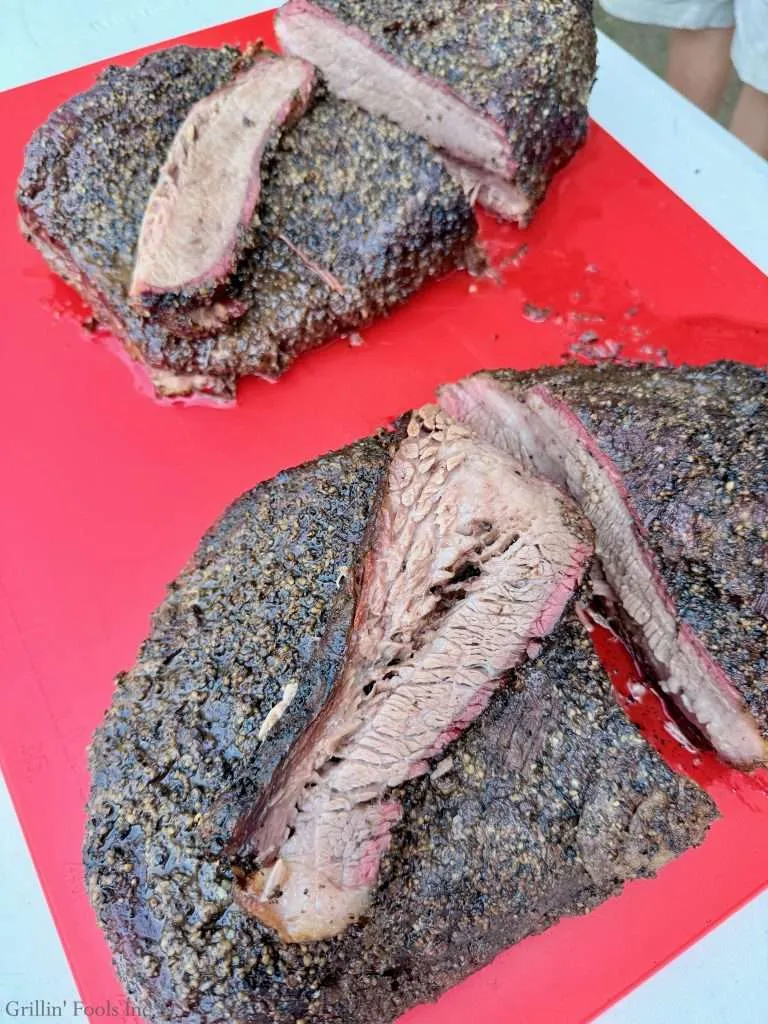
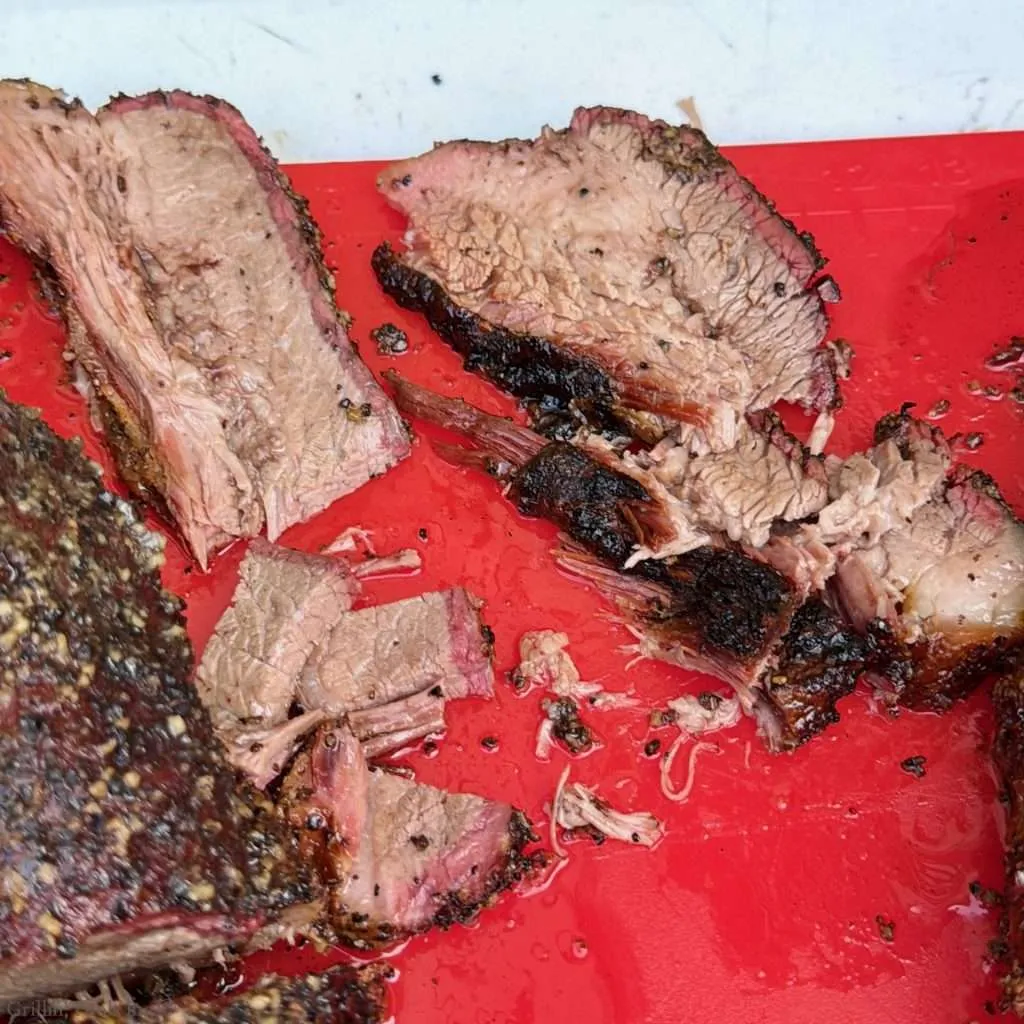
So we carved a slice from each and did a little side by side taste test.
Always have a Control Group
Let’s talk about side-by-side for a minute. Never try something new without a control. Someone told me about wet brining ribs so I brined a slab and tasted it without a control. They just tasted like the ribs I normally eat and therefore I didn’t do the extra effort to brine ribs for another 2 years and then I did it with a control. Holy smokes, was I wrong. The brined ribs were soooo much better. I then did the wet brined ribs with a control for all my friends and family but did the taste test blind for them. It was 100% to nil. Wet brined to not brined. Don’t repeat my mistake.
Should You Dry Brine Smoked Beef Brisket?
We are at the point in this post where I reveal which one was the better brisket. To see that answer, you need to watch the video below. But, I also hate it when people do that to me, so I will meet you in the middle with the answer below the recipe card and extra pics I use for Pinterest below
So let’s get the procedural stuff out of the way as you scroll down to see the answer….
If you have any questions or comments about dry brined brisket, feel free to leave them below or send me an email.
Also, if you could leave us a great review with lots of stars ⭐️⭐️⭐️⭐️⭐️ that would be most appreciated!
Additionally, you can follow us on our GrillinFools Facebook, Instagram, Pinterest, Twitter/X and YouTube feeds
Dry Brine Experiment Recipe Card
Print
Should You Dry Brine Smoked Beef Brisket?
We take two briskets and cook them the exact same way, only one is dry brined and the other is not to answer if you should dry brine smoked beef brisket
Course Barbecue, BBQ, Brisket, Entree, Main Course
Cuisine American, American Fare, Barbecue, BBQ, Beef Brisket, Brisket, Traditional American
Keyword Aluminum Foil, Beef Brisket, Beef Tallow, Beef Tallow Brisket, Brine, Brined, Brisket, Cambro, Dry Brine, Dry Brined, Foil, Foiled, Green Mountain Grill, Green Mountain Grills, Inject, Injected, Injected Brisket, Pellet Cooker, Pellet Grill, Pellet Smoker, Rest, Resting, Salt Pepper Garlic, Salt Pepper Garlic Seasoning, Smoked Beef Brisket, SPG, SPG Rub, SPG Seasoning
Prep Time 30 minutes minutes
Cook Time 6 hours hours
Resting Time 3 hours hours
Servings 24 people
- 2 Briskets, trimmed They need to be similar size and weight
- Salt Pepper Garlic seasoning Or your favorite beef rub
- Meat injection
- 1 cup Beef tallow
Trim the excess fat from both briskets and season one with your preferred beef rub. We used a store-bought SPG seasoning with some additional extra coarse black pepper. The other brisket got no seasoning whatsoever. Both briskets were wrapped in foil and placed in the fridge overnight.
The morning of the cookout, the second brisket was seasoned just like the one that was dry brined. Both had the flats injected with an off-the-shelf meat injection. Both were placed in 250F pellet smokers.
When the bark got good and dark around the 4.5 hour mark of the cookout and the briskets were sitting around 170F, they were removed from the smokers and placed on a large sheet of aluminum foil. Three large dollops of beef tallow was placed on top and the foil was folded around each brisket, tightly. The foiled briskets were placed back in the smoker until they reached 200F-201F
Once the briskets hit 200F they were put in the Cambro for about 3 hours before they were sliced.
Bonus Pics for Pinterest:
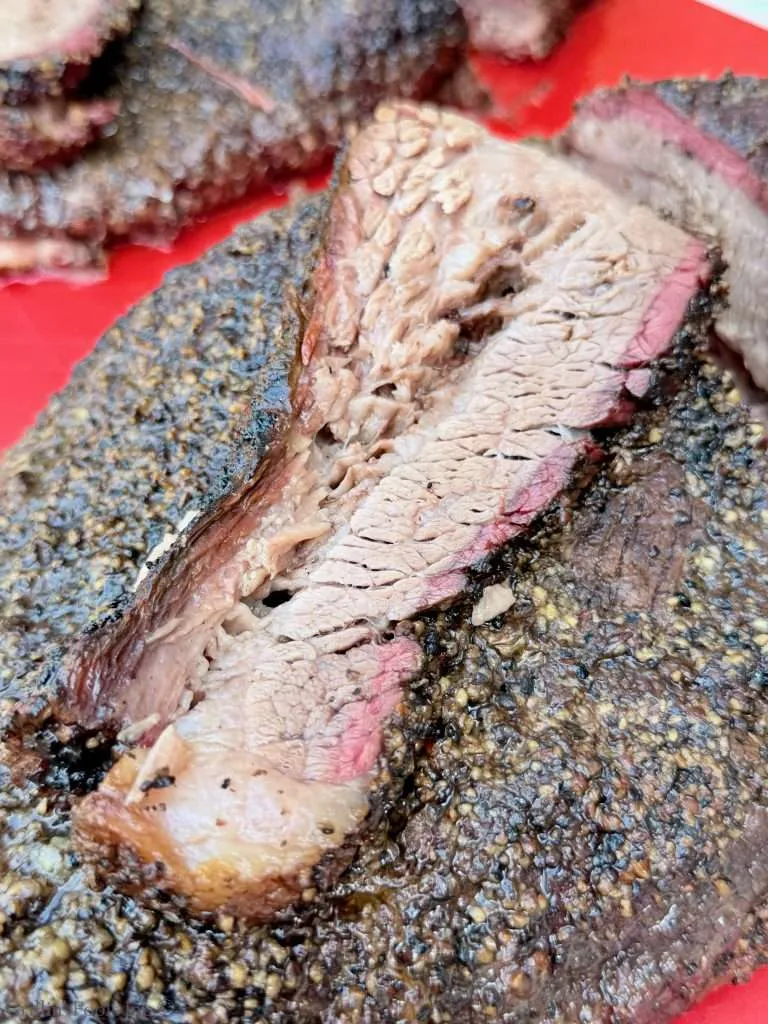
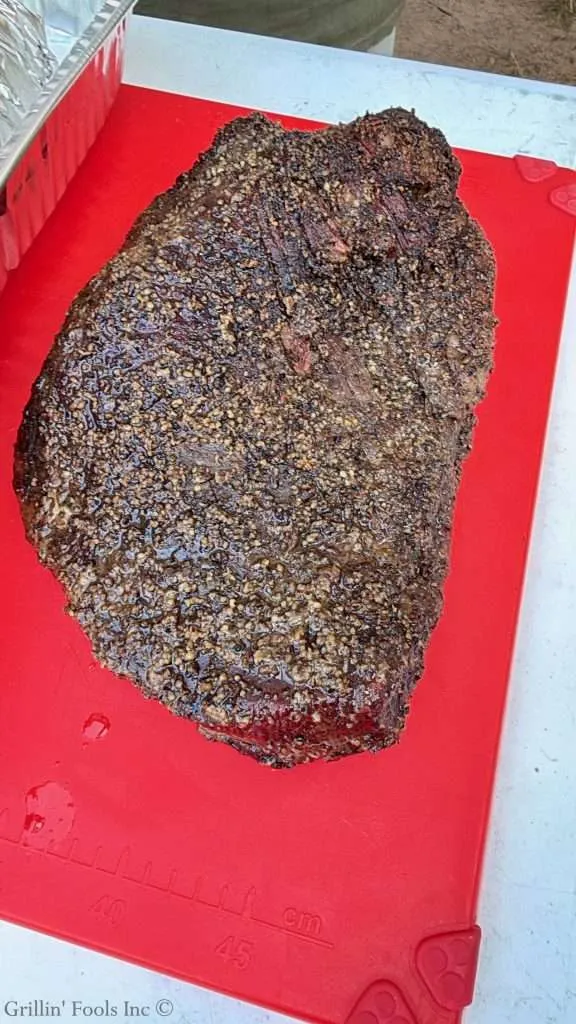
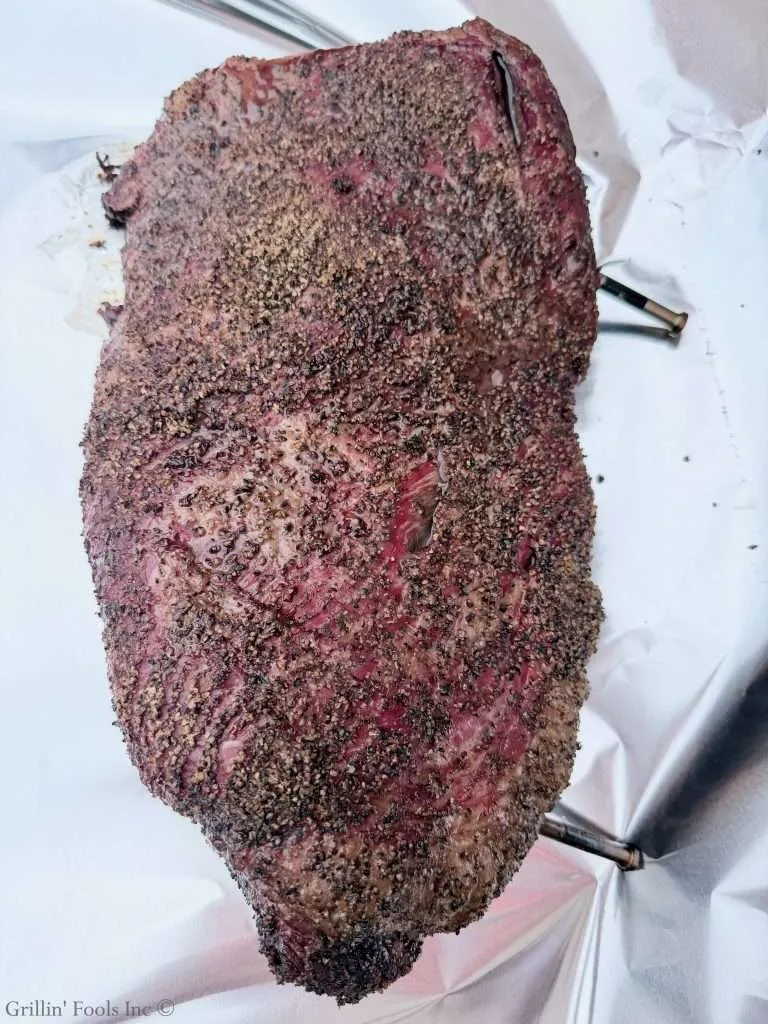
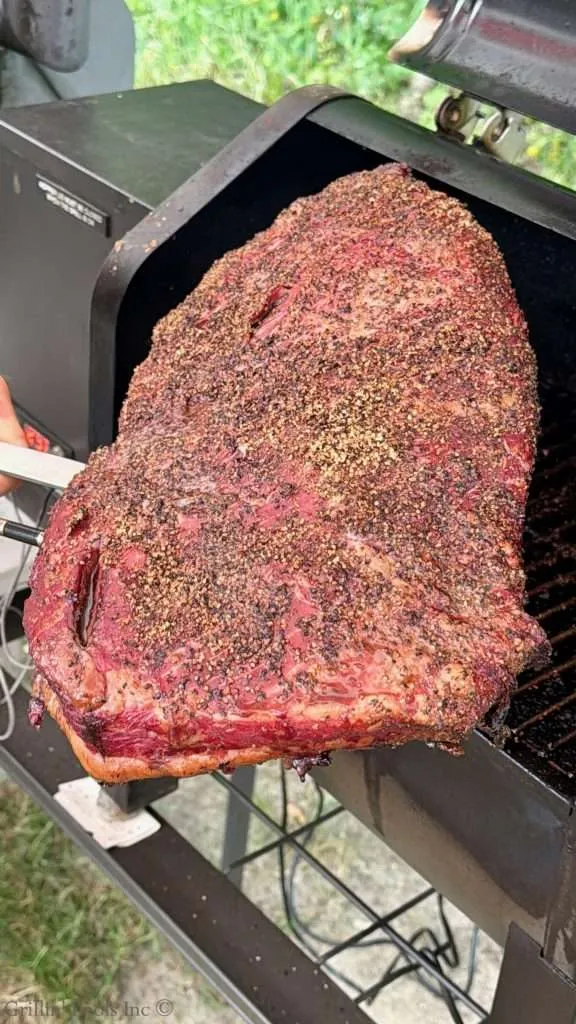
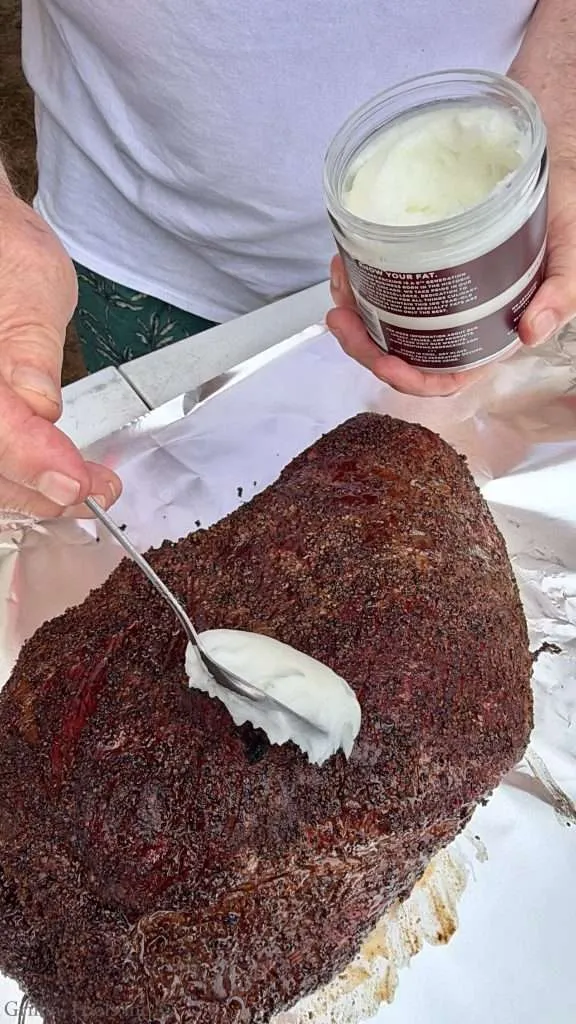
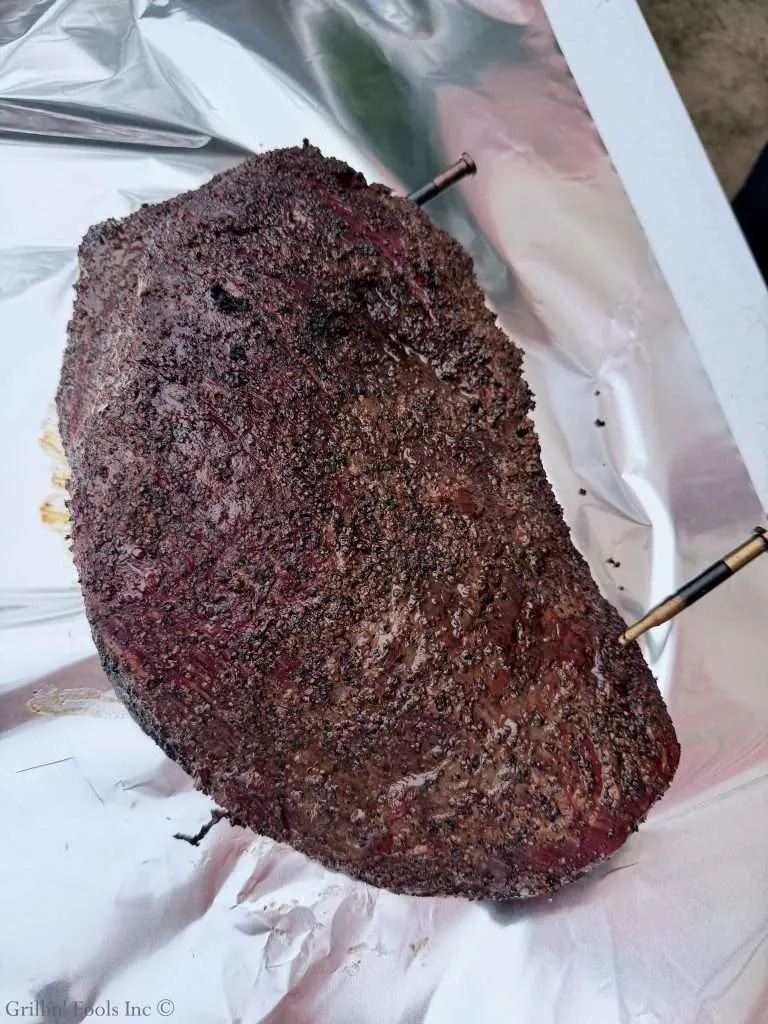
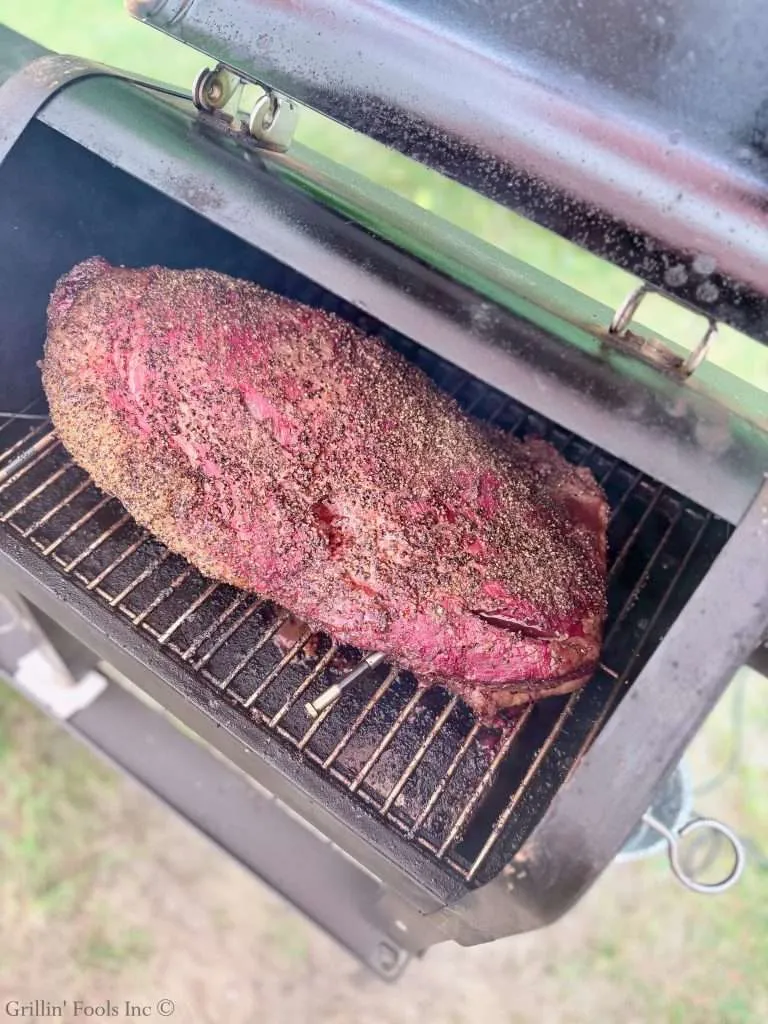
Which was Better?
The dry brined brisket was significantly better. The one that wasn’t brined was still amazing, but there was a distinctly more seasoned flavor profile to the dry brined brisket. Going into this, I fully expected there not to be much difference. In the video I say that I expected the opposite of these results. I misspoke. I didn’t expect the opposite. I expected the test to be inconclusive. But it was definitely conclusive and I will be dry brining from now on.
The post Should You Dry Brine Smoked Beef Brisket? first appeared on GrillinFools.
Did you miss our previous article...
https://manstuffnews.com/backyard-grilling/grilled-dirty-cabbage
 Backyard GrillingWeekend WarriorsAdvice from DadBeard GroomingTV Shows for Guys4x4 Off-Road CarsMens FashionSports NewsAncient Archeology World NewsPrivacy PolicyTerms And Conditions